

Wars in the Middle East and Ukraine have dominated the opening two days of the G7 summit in France, pushing host country France’s economic agenda to the backburner as leaders of the Group of Seven countries pivoted their focus towards escalating geopolitical tensions and grappled with divisions within the Western alliance.
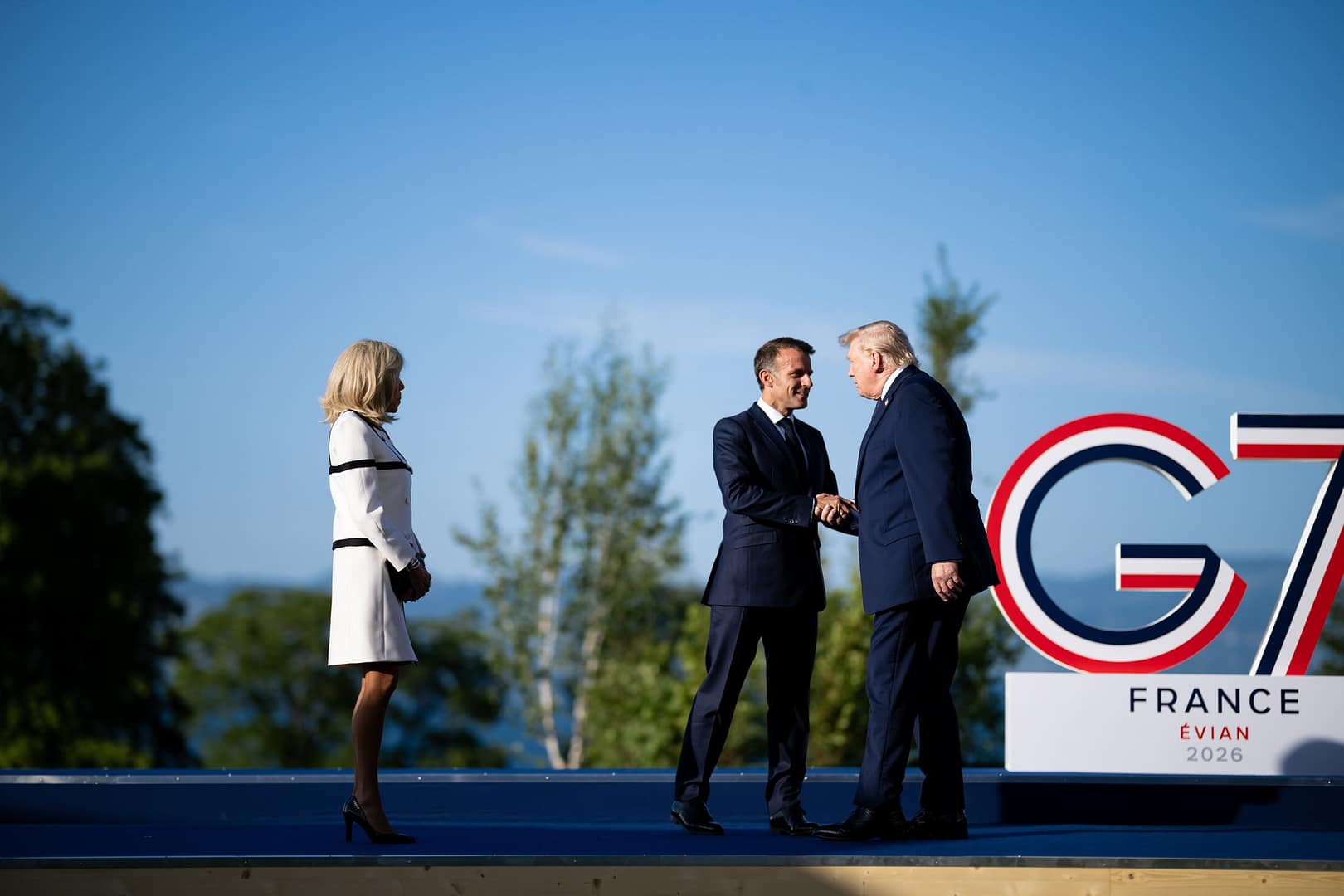
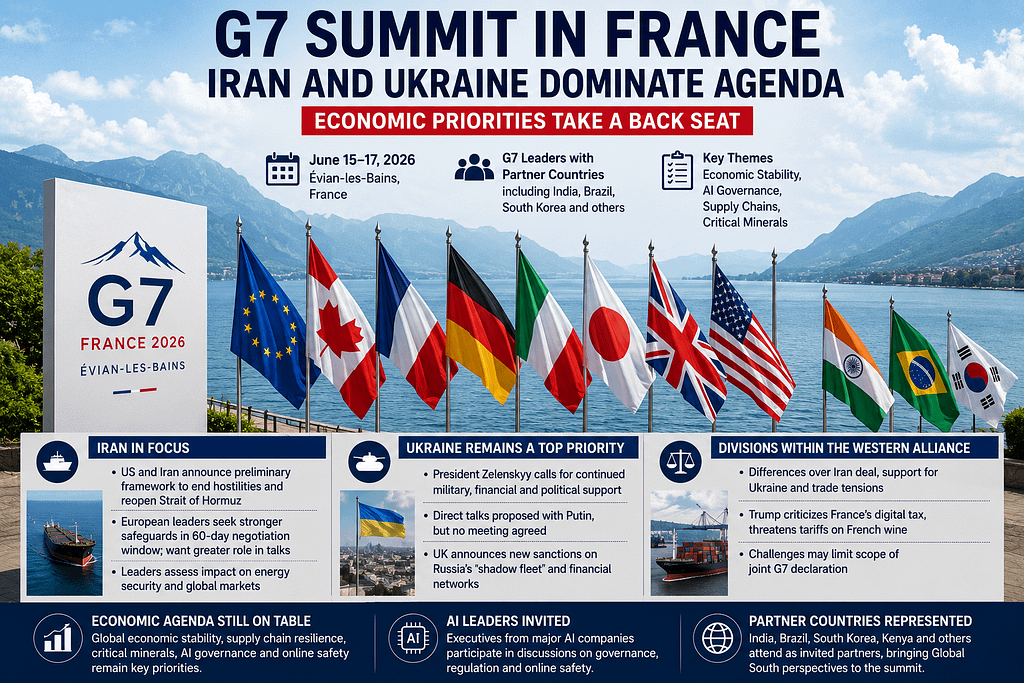
The three-day summit, being held from June 15 to 17 in the lakeside town of Évian-les-Bains, has brought together world leaders from Canada, France, Germany, Italy, Japan, the United Kingdom, the United States and the European Union (non-enumerated member), along with invited partner countries including India, Brazil, Kenya and South Korea.
Earlier, French President Emmanuel Macron had planned to focus discussions on economic stability, supply-chain resilience, critical minerals and international governance of artificial intelligence. According to Council of the European Union, however, a preliminary U.S.-Iran diplomatic agreement and the ongoing war in Ukraine quickly became the summit’s dominant issues.
Day 1: Iran framework reshapes summit agenda
The summit opened on Monday just after the United States and Iran unveiled a preliminary diplomatic framework aimed at ending hostilities and reopening the Strait of Hormuz, one of the world’s most critical maritime energy corridors. Reuters reported that U.S. President Donald Trump promoted the agreement as a breakthrough and said details would be released soon. Questions, however, remain about how the arrangement would work in practice.
The development immediately redirected leaders’ attention toward Middle East security, energy markets and the stability of global trade routes.
Ukrainian President Volodymyr Zelenskyy, meanwhile, sought renewed military, financial and diplomatic support from allies as Russia’s war entered another prolonged phase. Zelenskyy said he had proposed direct talks with Russian President Vladimir Putin, although no meeting was agreed upon, Reuters quoted as saying.
Trade frictions also surfaced early in the summit after Trump renewed criticism of France’s digital services tax and reiterated threats of tariffs on French wine exports, underscoring lingering tensions between Washington and its European partners.
Day 2: Europe presses for stronger Iran safeguards, renewed Ukraine strategy
On Tuesday, European leaders intensified efforts to shape the next phase of U.S.-Iran diplomacy.
According to Reuters, France and other European governments want a stronger and more comprehensive agreement than the preliminary framework currently on the table. Officials have expressed concern that the proposed 60-day negotiation period may not provide sufficient safeguards to prevent Iran from rebuilding its nuclear and missile capabilities.
European leaders are also seeking a larger role in the negotiations after being largely excluded from recent U.S.-Iran discussions.
Ukraine remained another major focus.
European governments used the summit to coordinate their approach toward Washington and encourage continued pressure on Moscow. Britain announced additional sanctions targeting Russia’s so-called “shadow fleet” and financial networks used to circumvent existing restrictions.
Behind closed doors, Zelenskyy met G7 leaders to discuss military support, sanctions and future peace efforts as Kyiv faces uncertainty over long-term Western backing.
Economic agenda pushed aside but not abandoned
Despite the geopolitical focus, France’s broader priorities remain formally on the agenda.
According to official G7 documents, leaders are still expected to discuss: global economic imbalances; more resilient supply chains; access to critical minerals; international partnerships; the future governance of artificial intelligence; and online safety.
Senior executives from major AI companies have also been invited to participate in discussions on AI governance and regulation.
India highlights Global South priorities
Prime Minister Narendra Modi is attending the summit as an invited partner-country leader alongside representatives from Brazil, Kenya and South Korea. India is expected to emphasise energy security, sustainable development, technology cooperation and resilient supply chains, although specific interventions had not been publicly detailed by Tuesday afternoon.
Divisions could limit final outcomes
The summit concludes on June 17, with leaders expected to issue statements on several topics. However, disagreements over Iran, trade and Ukraine could limit the scope of a broad unified declaration.
European leaders are also attempting to bridge differences with Trump, particularly over Iran and the strategy toward Russia, as they seek to preserve Western unity amid multiple international crises.
(Reporting based on Reuters, AP and official G7 summit information.)