
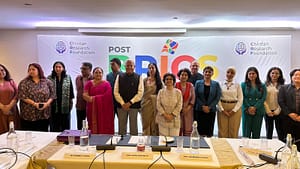

NEW DELHI, Sept. 23, 2026 /debcubspark.com-DigiTIMES./ — “India is an indispensable voice in the future of climate and energy policy. It is showing the world that clean energy is not a brake on prosperity, but a pathway to it,” said Minister Chris Bowen, Minister for Climate Change and Energy, Government of Australia, at a Pre-COP Dialogue, “Partners in Green Transition: Advancing Ambition, Action and Partnerships for COP31.” The dialogue was convened by Chintan Research Foundation (CRF) yesterday, in partnership with the Australian High Commission in India at The Claridges, New Delhi. It brought together policymakers, diplomats, researchers and climate practitioners to discuss pathways for translating climate commitments into implementation ahead of COP31.
Opening the session, Mr Shishir Priyadarshi, President, CRF, emphasised that the scale and urgency of the climate transition make partnership indispensable. He called for greater mobilisation of private capital, particularly towards countries facing the greatest financing constraints, and highlighted the persistent gap between climate commitments and delivery.
In his keynote address, Minister Bowen further highlighted the Pre-COP process as an opportunity to build momentum on key priorities including mitigation and climate finance. Describing India as an indispensable voice in the future of climate and energy policy, he pointed to the country’s clean energy expansion and stressed that the transition to clean energy can be a pathway to prosperity. He also emphasised that COP31 will be inclusive and transparent, with electrification, investment certainty and an emphasis on elevating the voices of Pacific Island Countries, including through Pre-COP events in Fiji and Tuvalu.
H.E. Ali Murat Ersoy, Ambassador of the Republic of Türkiye to India, highlighted that climate finance must be viewed as a strategic investment in global stability rather than simply a burden or a cost. He noted that Türkiye’s priorities as the host of COP31 align with India’s approach of Vasudhaiva Kutumbakam (“the world is one family”) and emphasised the need to align climate action with sustainable development.
The inaugural panel brought together H.E. Philip Green, High Commissioner of Australia to India; H.E. Kenneth Felix Haczynski da Nóbrega, Ambassador of Brazil to India; H.E. Jagnnath Sami, Ambassador of Fiji to India; H.E. Jason Hall, Ambassador of Jamaica to India; H.E. Nebiyu Tedla, Ambassador of the Federal Democratic Republic of Ethiopia to India; and Ms. Rajasree Ray, Senior Economic Advisor, Ministry of Environment, Forest and Climate Change, Government of India, in conversation with Ms. Gaurie Dwivedi, Executive Editor, NDTV.
The discussion revolved around the need to move from climate consensus to credible implementation, with finance, resilience, equity, technology access and international cooperation emerging as interconnected priorities.
- H.E. Philip Green, High Commissioner of Australia to India, noted that countries are galvanised around a common objective: keeping 1.5°C within reach through accelerated implementation and the energy transition. As COP31 President of Negotiations, Australia is focused on listening, building consensus and delivering practical outcomes. A pre-COP with the Pacific family will highlight the existential threat climate change poses to the region and the need for implementation and credible delivery to remain front and centre at COP31.
- H.E. Kenneth Felix Haczynski da Nóbrega, Ambassador of Brazil to India, stressed that with critical climate commitments already on the table, the focus must now shift towards implementation.
- H.E. Nebiyu Tedla, Ambassador of the Federal Democratic Republic of Ethiopia to India, brought questions of equity and common but differentiated responsibilities into focus, alongside persistent implementation barriers including high costs of capital and limited access to finance.
- Ms Rajasree Ray, Senior Economic Advisor, Ministry of Environment, Forest and Climate Change, Government of India, highlighted India’s strength in contributing to early-warning, disaster-resilience and meteorological services across the Global South, while stressing that finance remains a critical enabler. She also pointed to the importance of critical minerals and clean-technology supply chains and India’s demonstrated leadership through its NDCs.
- H.E. Jagnnath Sami, Ambassador of Fiji to India, called for partnerships that translate into practical cooperation, stronger national capacity, technology and finance for countries and communities on the front lines of climate change.
- H.E. Jason Hall, Ambassador of Jamaica to India, highlighted the disproportionate impact of climate change on vulnerable countries and called for enhanced support and more direct access to climate finance.
Taken together, the discussion highlighted an evolving climate diplomacy in which finance, technology, resilience and partnerships must translate commitments into outcomes on the ground. Speakers also underscored the importance of multilateralism and wider participation by businesses and civil society, alongside stronger and more resilient clean-technology supply chains.
The symposium also featured three thematic sessions on climate-resilient infrastructure and the transition from vulnerability to resilience; financing climate ambition for green transitions; and cooperation on critical minerals and clean technologies for energy security and decarbonisation. A fireside chat further examined India’s role and capabilities in advancing the Global South’s priorities on the road to COP31.
The discussions from the symposium will feed into the broader COP31 dialogue in Türkiye in November 2026, contributing perspectives on ambition, implementation, climate finance and partnerships needed to advance a resilient, inclusive and equitable global green transition.
.