

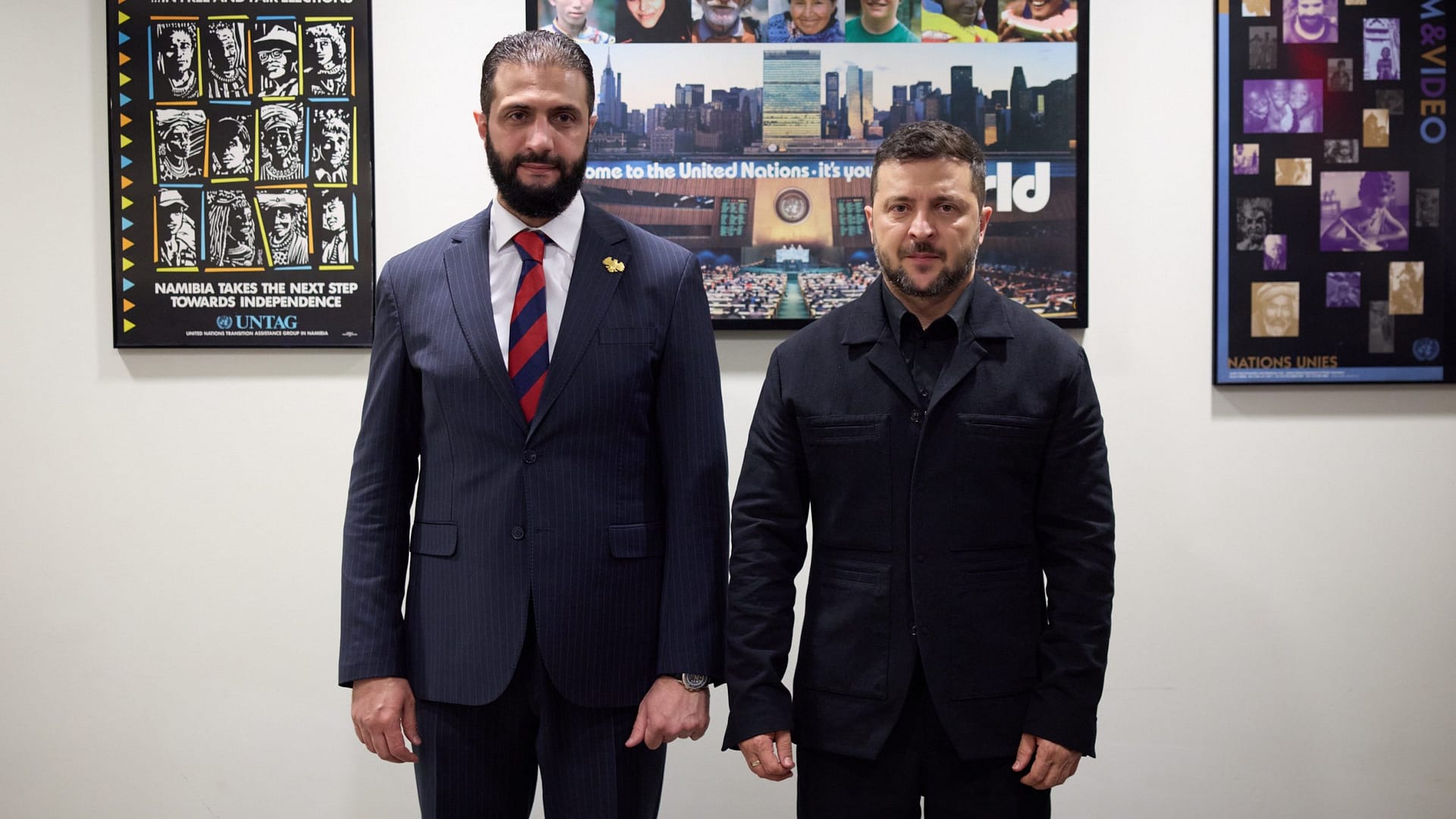
On the sidelines of the 80th United Nations General Assembly, Ukrainian President Volodymyr Zelenskyy and Syria’s interim President Ahmed al-Sharaa signed a communique to restore diplomatic relations. The leaders also discussed potential areas of cooperation, shared security threats, and the importance of countering them. Zelenskyy emphasized that both sides would rebuild ties on the basis of mutual respect and trust.
This rapprochement follows Ukraine’s early outreach to Syria after the ouster of Bashar al-Assad in December 2024, when Kyiv was the first to send a high-level delegation.
Relations between the two countries had been frozen since 2014, when Russia’s annexation of Crimea and aggression in Donbas reshaped global alignments. That year, Syria voted against a UN resolution supporting Ukraine’s territorial integrity, reinforcing its position as a Russian ally. In 2016, Ukraine evacuated its embassy in Syria to Lebanon due to security concerns, though Syria’s mission in Kyiv remained until 2018. Diplomatic ties were officially severed in 2022 after Assad’s regime openly supported Moscow’s invasion of Ukraine.
The final rupture came in July 2022, when Syria recognized the “independence” of the Russian-backed Donetsk and Luhansk republics. In response, Ukraine cut all diplomatic ties, and Damascus reciprocated shortly thereafter based on the “principle of reciprocity”.
Relations deteriorated further when reports emerged in 2023 that Russia, through the Wagner Group, was recruiting Syrian fighters—soldiers, ex-rebels, and veterans who fought against the Islamic State Group—to fight in Ukraine. Although currently no reports are available regarding the presence of Syrian fighters fighting against the Ukrainian troops. However, it underscored the depth of Russian-Syrian military coordination.
Against this backdrop, the renewed dialogue between Kyiv and Damascus carries significant geopolitical weight. For Russia, it poses uncomfortable questions. Moscow maintains a major air base at Hmeimim in Latakia and a naval facility in Tartous. These strategic assets play a key role in Russian logistics across West Asia and Africa. The fall of Assad forced the Kremlin into immediate engagement with the al-Sharaa government, even as Assad himself took refuge in Moscow. For the Kremlin, cultivating ties with Syria’s new leadership is essential to preserving its strategic foothold.
Ukraine’s resumption of relations with Syria, therefore, may complicate Russia’s regional calculus. By rebuilding trust with Damascus, Kyiv not only reopens a diplomatic channel long closed but also symbolically challenges Russia’s influence in the country, including the defence bases. While the practical outcomes of this renewed partnership remain to be seen, the move signals a subtle yet significant shift in the geopolitics of both Eastern Europe and West Asia.