


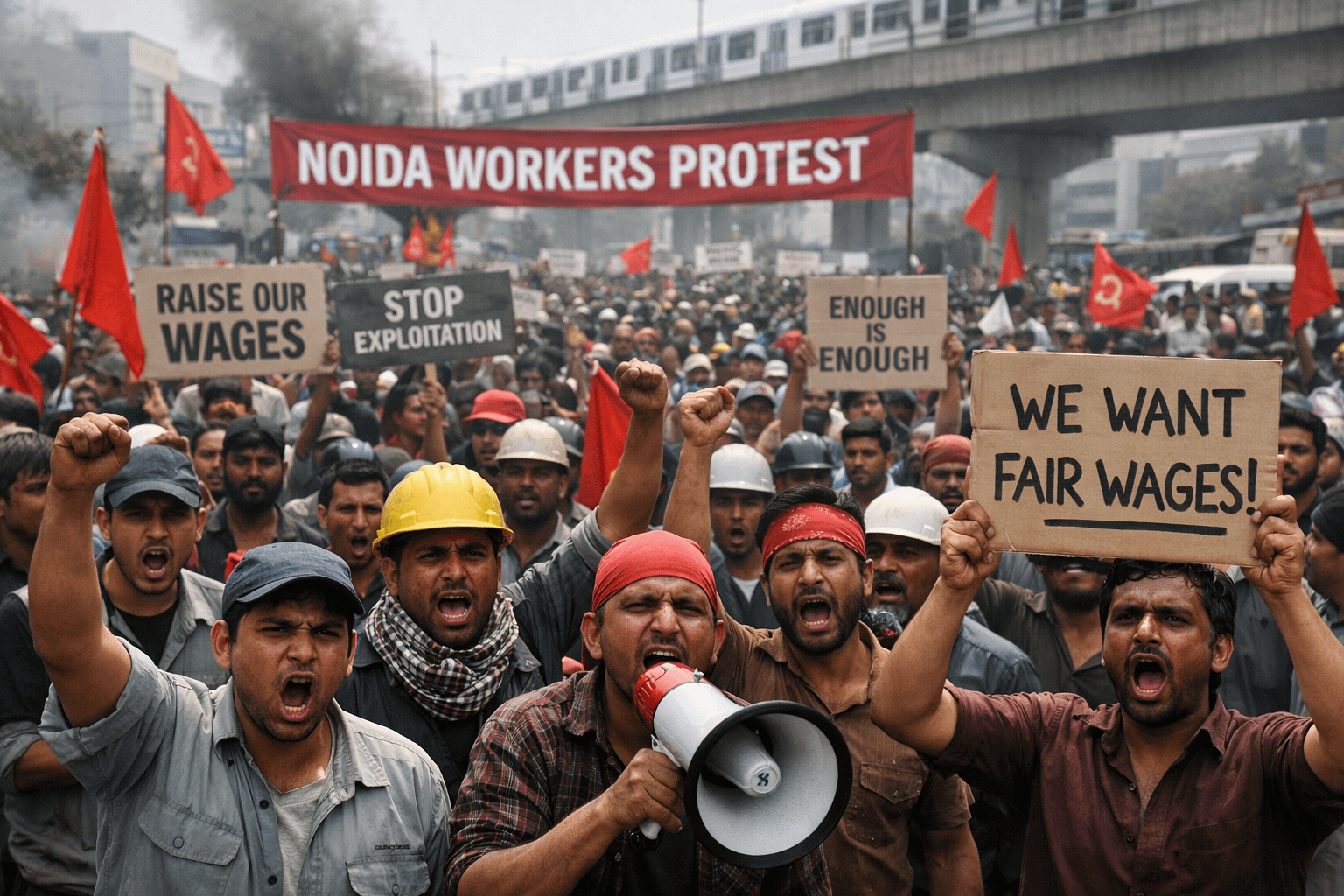
“₹13,000 a month in NCR is not a wage—it is a constraint,” says a worker. Not thinly, but nearly, it’s this angst of workers that reflects in the ongoing protest in Nodia.
Inside the industrial cluster of Noida Phase 2, a wage dispute triggered workers’ protest on the evening of April 12, which escalated the next morning after workers from multiple factories began gathering over wage-related unresolved grievances. Early demonstrations were peaceful, with workers raising slogans and assembling outside factory gates.
In the next 48 hours, the protest spiralled into one of the most significant labour flashpoints in the National Capital Region (NCR), spreading quickly across nearby industrial clusters, particularly Hosiery complex and Sector 63/62 belts. The situation snowballed into law-and-order crisis as tens of thousands of workers resorted to stone pelting, arson and vehicle damage.
According to The Economic Times, over 300–350 people have been arrested so far in connection with violence, vandalism and arson.
Taking to X, Gautam Budhha Nagar DM Medha Roopam said, “A review of the situation was conducted at ground zero alongside the esteemed Police Commissioner. Instructions were issued to the concerned officials for continuous and effective monitoring, and an appeal was made to the worker brothers and sisters to maintain peace.”
Despite government intervention, clashes between workers and police have been reported again today. In response to escalating tensions, Noida Police conducted Flag March in areas like Sector 121 and industrial clusters. Heavy police deployment continues across industrial clusters to prevent escalation.
According to sources, authorities are maintaining round-the-clock surveillance and rapid response team equipped with riot-control gear. High-tension zones remain barricaded.
From Factory Floors to City Streets
Not overnight it has boiled over. The protest has been the outcome of the long-standing wage-related grievances. At the heart of it is the widening gap between wages and urban survival costs. Official wage revisions fail to reflect inflation, while enforcement of labour norms remains inconsistent. Workers continue to reel under structural anxieties such as fair wage revisions aligned with inflation, payment for overtime, predictable working hours and enforcement of labour protections that workers claim remain largely absent on the ground.
Escalation and Breakdown
By April 13, the situation had escalated sharply. Protest sites spilled onto arterial roads, with workers blocking key routes connecting Noida to Delhi. What began as a labour assertion soon took on the contours of a law-and-order challenge.
Incidents of stone pelting, damage to vehicles, and confrontations with police were reported from several pockets. Law enforcement responded with crowd-control measures, including the use of tear gas, while detaining hundreds of protesters. Authorities have confirmed that over 300 individuals have been taken into custody in connection with the violence.
The scale and speed of escalation underline the fragile equilibrium within NCR’s industrial economy—where high employment density, low wage growth, and rising living costs intersect.
Traffic Paralysis and Urban Spillover
The protests also triggered significant spillover effects across the NCR’s mobility network. Key routes—including those connecting Noida to East Delhi—experienced severe congestion as demonstrators blocked roads and police erected barricades to contain the unrest.
For hours, commuters were stranded in gridlocked traffic, highlighting how industrial unrest in peripheral zones can quickly disrupt the wider urban ecosystem. While traffic conditions have partially stabilised, authorities remain on high alert, anticipating further mobilisation.
Government Response: Relief or Reaction?
In response to mounting pressure, the Uttar Pradesh government has announced a revision in minimum wages across categories, with retrospective effect from April 1, 2026. Officials have also indicated that several worker demands—including overtime compensation and workplace compliance measures—are being addressed through negotiations with industry stakeholders.
However, the timing of the announcement has raised questions about whether the wage hike is a proactive reform or a reactive measure aimed at containing unrest. Worker groups on the ground suggest that while the revision is a step forward, it does not fully bridge the gap between wages and rising living costs.
Politics, Narrative, and the Question of Control
As the protests intensify, the political narrative around them is also evolving. Opposition voices have linked the unrest to inflationary pressures and alleged labour exploitation, while sections within the administration have hinted at the possibility of external instigation, suggesting that the scale of mobilisation may not be entirely organic.
This divergence in narratives reflects a broader contest over how labour unrest is framed—either as an economic signal or a law-and-order aberration.
The Bigger Picture: A Warning Signal
The Noida protests are more than a localized disruption; they are a signal of deeper shifts within India’s industrial labour landscape. With manufacturing clusters expanding rapidly in NCR and neighbouring regions, the pressure on wage structures and labour conditions is intensifying.
The events of April 12–14 demonstrate how quickly industrial grievances can cascade into mass mobilisation when underlying issues remain unaddressed. The protest’s rapid spread across factories and sectors suggests a shared pool of discontent rather than isolated disputes.
What Lies Ahead
The immediate question is whether the government’s interventions will succeed in de-escalating tensions. Much will depend on how effectively wage revisions are implemented and whether assurances on working conditions translate into enforceable changes.
Equally critical is whether the unrest remains contained within Noida or spills over into adjacent industrial belts such as Greater Noida, Ghaziabad, Faridabad, and Bhiwadi—regions that share similar labour dynamics.
For now, Noida stands at the centre of a fast-evolving industrial confrontation—one that has exposed both the vulnerabilities and the volatility of India’s urban manufacturing economy.
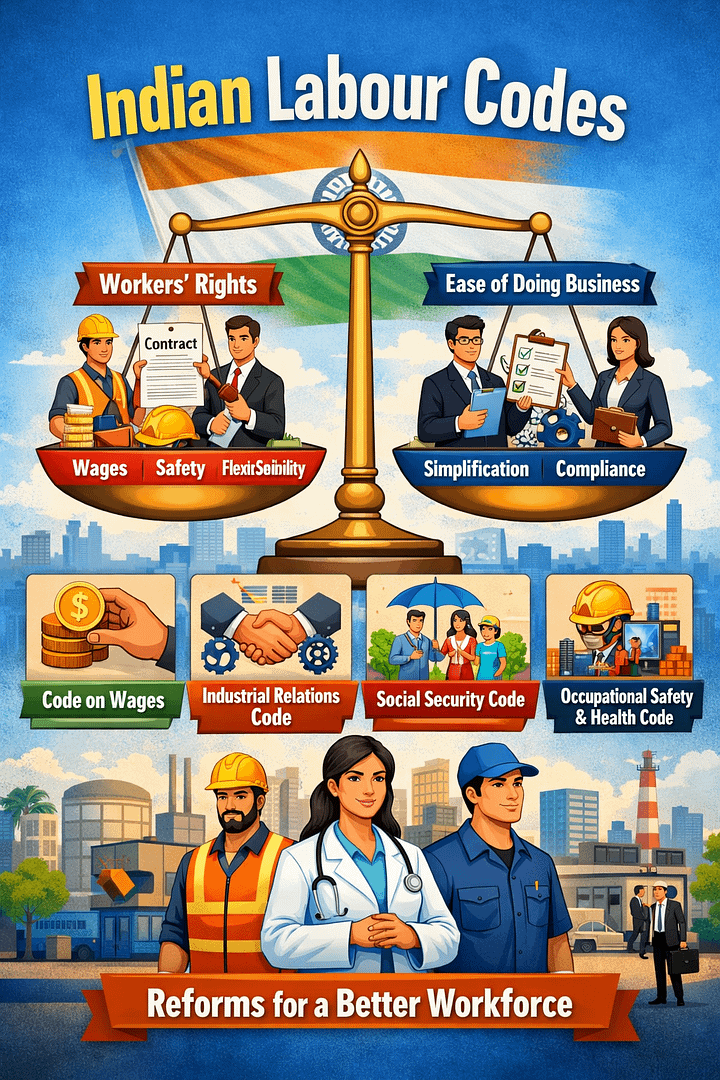
The Four Labour Codes: Reform, Reality and the Impact on Establishments – DigiTIMES.