


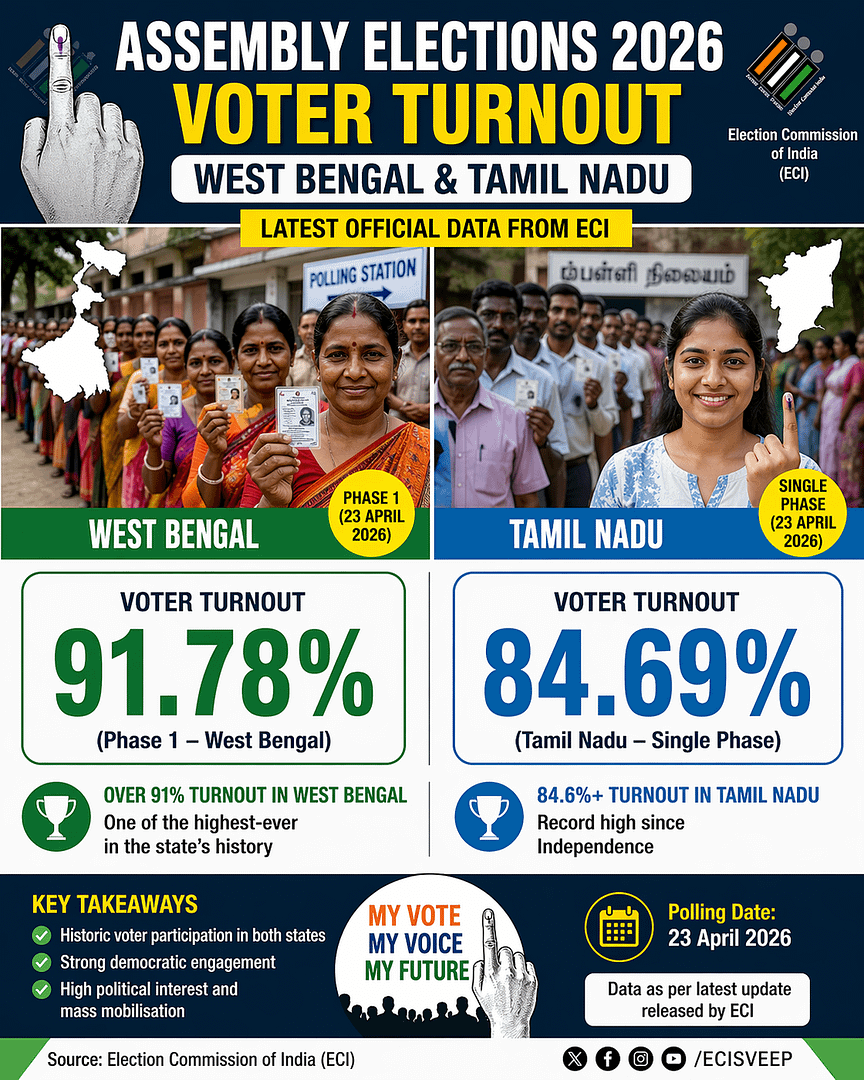
Voters in West Bengal and Tamil Nadu turned out in large numbers for the 2026 Assembly elections, with both states recording robust polling percentages by the end of voting day.
According to end-of-day ECI (Election Commission of India) estimates, West Bengal registered a voter turnout of approx. 91.78%. Meanwhile, Tamil Nadu recorded a voter turnout in the range of 82–85%. Both states have outperformed the earlier records of 82.3% and 73.83%, respectively. This increasingly reflects steady and widespread participation across urban and rural constituencies.
Bengal Leads with Near-90% Participation
West Bengal’s turnout figures stand among the highest in recent electoral cycles. From northern districts to the southern belt, polling stations witnessed consistent voter queues throughout the day. The near-90% turnout highlights not only strong party-level mobilisation, but also sustained voter enthusiasm in a politically competitive environment.
Tamil Nadu Records Strong, Stable Turnout
In Tamil Nadu, polling progressed smoothly with turnout crossing 80% well before the close of voting. While slightly lower than West Bengal, the state’s 82–85% turnout range reflects a stable and mature voting pattern, consistent with its past electoral trends.
Urban centres such as Chennai saw moderate participation, while rural and semi-urban regions contributed significantly to the overall numbers.
Democratic Momentum Ahead of 2029
The high voter turnout in both states signals a deeper political churn and heightened public engagement ahead of the 2029 general elections. While West Bengal’s figures underscore intense electoral competition, Tamil Nadu’s steady participation points to a consistent democratic rhythm.
Together, the two states offer a compelling snapshot of India’s evolving electoral landscape—where regional narratives, governance debates and voter aspirations continue to drive strong participation at the grassroots level.