Political Feature
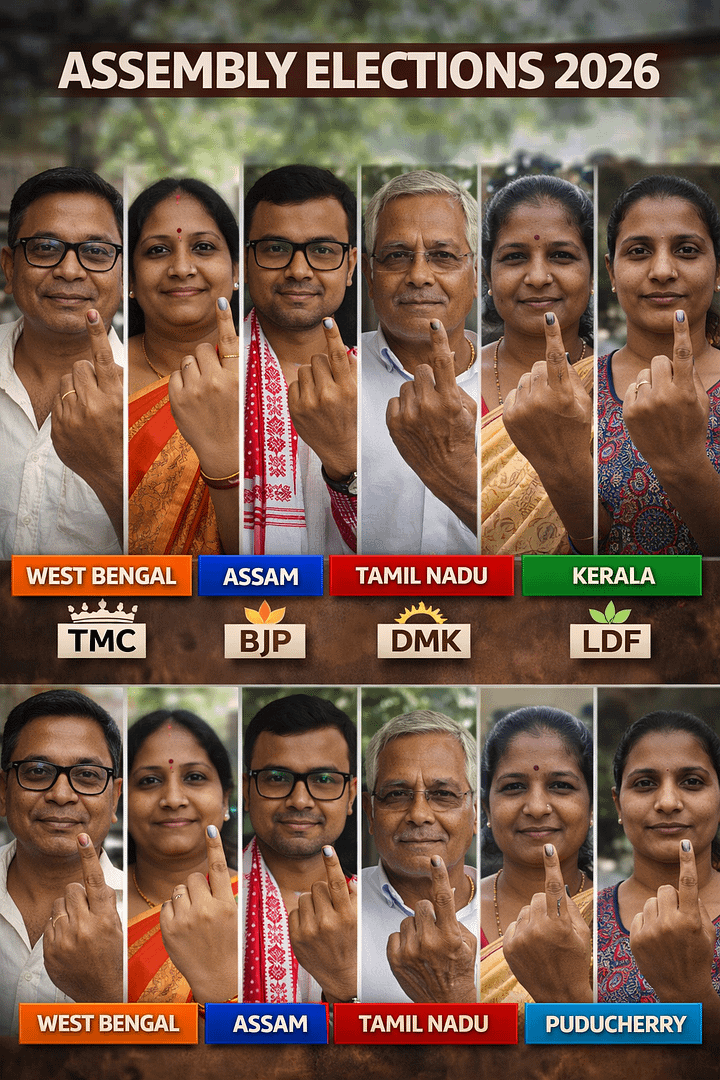
The path to India’s General Elections is paved through its states. The next National Elections would be no different! As assembly elections across West Bengal, Assam, Puducherry, Tamil Nadu and Kerala are due, a new political reality is evolving. The reality is that of a litmus test for stability of governments, local vs. national narratives, political adaptability, expansion of national footprints of the ruling dispensation and regional politics vs. national politics.
And unlike the landslide victories of the past, despite national leadership and regional satraps in the fray, the mandate of these state elections will be delivered on the basis of seat-by-seat, booth-by-booth and voter-by-voter contests. That wave factor is a once-in-a-while phenomenon in a political democracy can’t be contested. In fact, the bellwether of our time isn’t always the same. It keeps changing!
The Stakes: More Than Just States
At first glance, assembly elections are local affairs centring around roads, electricity, jobs, welfare schemes, law and order—these state indices dominate sate-level campaign narratives. Beneath this localised surface, however, lies a national undercurrent.
The high-stakes assembly elections due in April 2026 aren’t just a semi-final to the Lok Sabha elections of 2029, but also a test of durability of national leadership narratives, shape alliance formations across India and reveal shifts in voter behaviour, in particular – among youth and rural populations.
In many ways, they act as an acid test—measuring not just who is winning, but why.
The Fragmented Battlefield
Post 2014, India’s electoral map pivoted to a near uniformity. The challenge of retaining the uniformity in electoral politics is humongous. Despite its hits and misses, the BJP which made a sweeping comeback on the back of the failures of the old regime is pulling out all the stops to keep up with its electoral victories, both state-wise and nationally. The fever pitch victories of the past, starting 2014 and beyond is the trend seemingly losing traction given that the waves of time are short-lived. And hence the pivot is towards performance-based politics, and realpolitik where the body politic is driven by tangible benefits rather than just personality.
In context, these oncoming elections again have never been the stronghold of the ruling NDA-led BJP party, except for Assam and Puducherry where the BJP-NDA’s foray is relatively a recent history.
In West Bengal, however, it’s the TMC vs. BJP vs. Congress-Left, where the contest is deeply personality-driven, shaped by regional identity and political legacy. The current political state of affairs in West Bengal – once the CPM-ruled state – imbibes much from its precedents of high polarization and minority vote consolidation. Tamil Nadu, on the other hand, remains hooked to Dravidian politics, where ideology, welfare and linguistic pride converge. The DMK alliance vs. AIADMK + NDA contest would alter between regional dominance and national push. The BJP still has had no footprint in the Dravidian state sans its ally AIADMK part of the NDA alliance at the centre.
The LDF vs. UDF contest in Kerala, where the BJP is marginal but rising, would be that of cyclical duel, ideological clarity and high political awareness. The Left-rule state faces anti-incumbency – one, owing to its legacy of alternating mandate after every five years, two, it broke the historical trend in 2021. The incumbent Pinaraiya Vijayan-led LDF government this time around might make a comeback on the strength of its beneficiary-driven welfare schemes, and hence the narrative around the same could change the historical trend, again!
On the periphery, it’s the Assam state that reflects a blend of identity politics, governance narratives and demographic shifts. Assam is the gateway to other Northeastern states and the most cherished state on the BJP’s platter as it gotten the saffron party the biggest-ever mandate in the once Congress bastion. Chief Minister Himanta Sharma-led BJP-NDA squares off with the Congress alliance struggling to regain its lost stronghold after the CM shifted his loyalty from the Congress to the saffron party.
What unites these regionally diverse sates is a single emerging truth: No election can be won through a one-size-fits-all strategy anymore. Each state presents its own caste equations, economic concerns and leadership dynamics which aren’t static and the room for complacency doesn’t fit in the current state of political affairs.
The Rise of the Micro-Battle
In an evolving political landscape, elections are all about winning clusters of constituencies, precisely swing seats that are highly decisive and nearly unpredictable. Despite a significant number of safe seats across five states, the outcome of upcoming elections would be decided by swing zones mostly in West Bengal, Assam (after 2023 delimitation exercise), Tamil Naidu and Kerala where the major parties like the BJP and the Congress are yet to make a toehold. Interestingly, going by the past trends, these “micro-battles” in key constituencies shaped by hyper-local dynamics including candidates’ credibility, welfare delivery effectiveness, booth-level organisation and narrow victory margins (less than 10,000) can tilt the fate of the ruling party.
Elections are a dicey affair. Even minor shifts in voter sentiment in swing seats—constituencies with historically thin margins (often under 5,000–10,000 votes)—can flip outcome. And safe seats where stronghold parties get massive leads of 30,000+ votes provide strategic stability. It has been seen that a party leading in statewide vote share often fails to convert that support into seats. On the flip side, a well-targeted strategy in key constituencies often result in disproportionate gains. Therefore, elections are increasingly being decided—not just in rallies, but in ground networks and local equations.
Leadership: National vs. Local
- National: Who should lead the country?
- State: Who can govern me effectively?
In a maturing democracy like India, it has been observed that it’s more of a personality-driven politics than any singular political party such as the BJP or the Congress irrespective of its cadre strength nationally. Micro-battles are real-time challenges where demographics aren’t constant and largely shaped by changing tastes and preferences. In perspective, it’s both the leadership and micro-battles that define the outcome.
Dissecting voters’ choices is among the continuum of challenges before any political party that sports larger than life leaders having significant influence over their voters.
The differential however continues to exist between national and local leadership – one, the former still sets the tone, influences voter perception, shapes campaign narratives and provides ideological direction; two, local leaders are accessible, visible and responsive.
Welfare Politics and the New Social Contract
One of the most palpable changing dynamics of India’s elections has been driven by the rise of welfare politics. Direct benefit transfers, subsidised utilities, healthcare schemes and targeted financial support have had tangible impacts on the ground. It’s one welfare scheme over another that makes the present-day elections more challenging and dicier, over and above the voters’ sentiments that stand largely impacted by welfare schemes.
To put that into context, the binary between the NDA-led BJP vs. the Congress-led INDIA alliance mode of delivery of social welfare schemes over the last decade has become more of a competitive one with core philosophies standing apart from each other.
The NDA-BJP combine has delivered through national/uniform-scale targeted Direct Benefit Transfer (DBT) delivery and infrastructure growth like roads, digital and power. The BJP’s nationwide flagship schemes such as Pradhan Mantri Awas Yojana: Affordable housing; Pradhan Mantri Ujjwala Yojana: Free LPG connections; Jal Jeevan Mission: Tap water to rural homes; Ayushman Bharat: Health coverage; PM Garib Kalyan Anna Yojana: Free food grains are a multi-corner social welfare schemes that have improved lives and living of a billion population.
Whereas, the Congress-led INDIA alliance has focussed more on state-level income support and social justice programmes, as well as has expanded direct financial relief and subsidies. The Opposition-led key welfare schemes include women-focussed cash transfer schemes, free/subsidised electricity, free public transport for women, expanded food & social security schemes and education & scholarship expansion.
In fact, governance is no longer judged by intent, it is judged by impact. The beneficiary-driven social benefits have struck up a de facto social contract that clicks with the masses more than anything else as it is bound by give-and-take politics. Contextually, whether it be the BJP, the Congress or any regional party, it is the performance-based politics that gets a decisive edge. Rhetorics are for sure losing relevance given that tangible benefits are the order of the day.
Coalition Arithmetic: The Invisible Decider
There is a popular perception if elections are decided by voters, alliances increase the ‘winnability’ factor. It has been seen India’s electoral democracy chooses consolidation over fragmentation, probably due to the fact that vote splits throw up fractured mandates. For instance, in 2024 Maharashtra assembly elections, the Mahayuti (BJP-led Shiv Sena and NCP factions) vis-a-vis Maha Vikas Aghadi (Shiv Sena-led NCP and Congress) alliance advantage BJP, bagging it 235 out of 288 seats. Mahagathbandhan (RJD-led Congress and Left bloc) which is part of the broader INDIA-bloc (Congress-led) alliance has kept the Opposition vote share intact despite a massive seat loss to the NDA in 2024 Lok Sabha elections. The Opposition alliance has gone on to provide a united front for parties facing the political onslaught of the BJP-led NDA.
The Youth Factor
The youth factor in India’s elections is playing a decisive role, as over 60% of Indians are below 35 years of age. According to one estimate, the 2024 Lok Sabha elections saw approx. 21.5 crore voters in the age group 18-29 inclusive of 1.84 crore new voters who exercised their franchise.
First-time voters aren’t tied to historical loyalties, nor get swayed by inducements. What drive the youth to vote for one party over another are employment opportunities, education access, digital narratives and social mobility. The youth demographics were one of the instrumental factors in the BJP’s massive comeback in 2014 and 2019. The party secured 34% and 41% youth vote in respective Lok Sabha elections. The young voters are both a challenge and an opportunity for political parties. The demographic dividend is unpredictable and can swing elections.
The Bigger Picture
India’s elections are becoming more of a complex political exercise as the phenomenon ‘rising on the crest of electoral waves’ is seemingly losing traction. This is in no case a sign of instability. But rather an opportunity for reality check when democracy takes a new turn towards ‘next generation of voters’ who exercise their franchise independently without having to fall to inducements, make more conscious choices and demand more accountability.
These crucial state elections won’t just witness a powerful collusion of factors, but undercurrents of brewing key factors crashing against one another. No wonder swing constituencies will go on to hold sway tilting expected outcome. Alliance stability is another factor which if holds strong until last minute can override anti-incumbency. Whether welfare politics that dominate local, regional and national agenda will stand the test of time is something of a challenge to parties if it doesn’t translate into votes. Apart from that, leadership credibility is still supreme – enabling pro-incumbency. Local faces vs. national narratives have equal stakes to turn the tide, either way. Youth and women voters aren’t mere participants, but are real game-changers.
Last but not the least, in this new era of elections where ‘micro-battles’ can be a game-changer, the ultimate fact remains – electoral victories aren’t easy to come by.