

| By Dr Pooja Sehbag
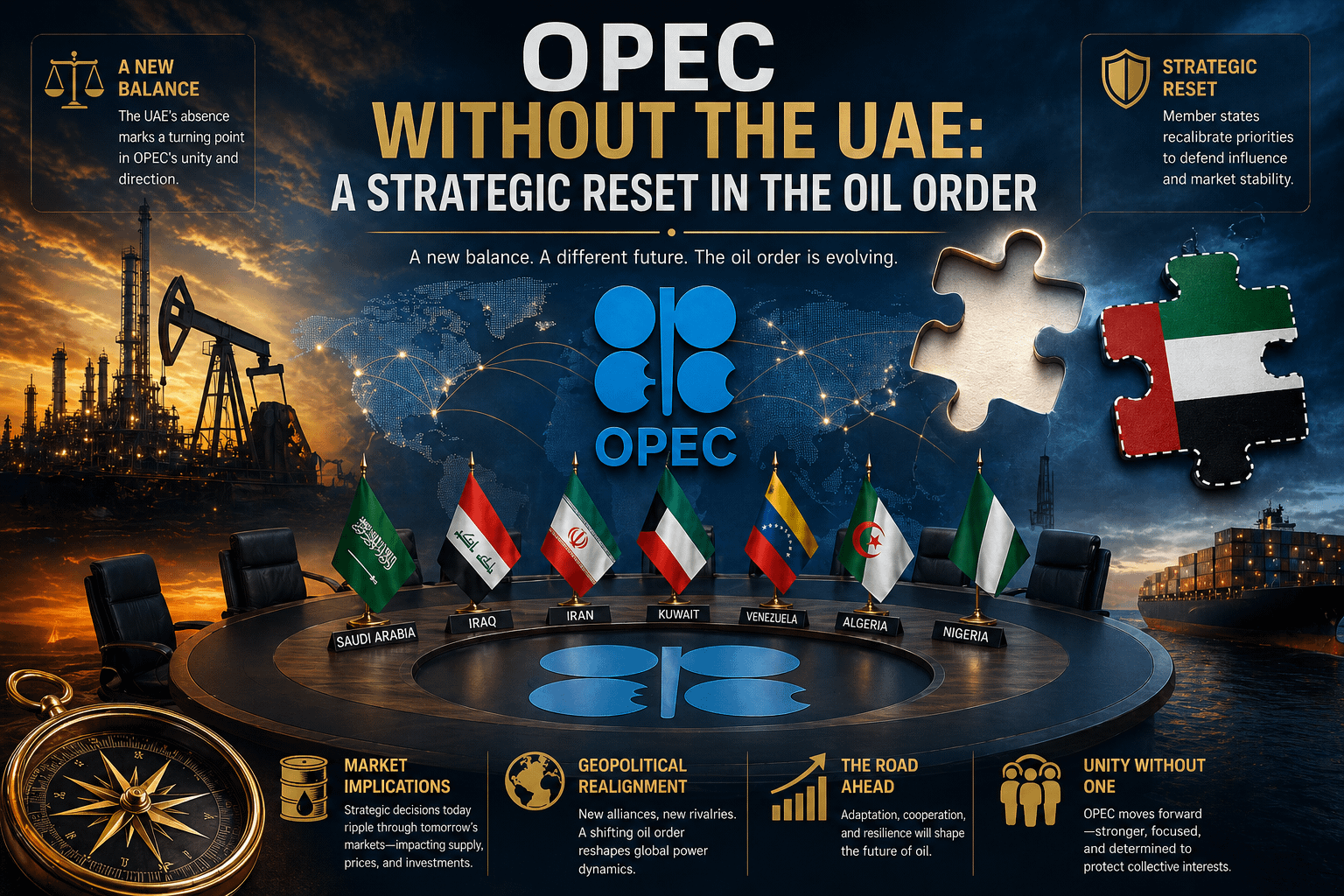
On 28 April 2026, the United Arab Emirates (UAE) announced its decision to exit the Organization of the Petroleum Exporting Countries (OPEC) and the broader OPEC+ framework, effective 1 May. As the fourth-largest producer within OPEC, accounting for roughly 11 per cent of the group’s output, the UAE’s departure carries significant implications for OPEC’s ability to influence global oil supply and price dynamics. A long-standing member of nearly six decades, its withdrawal also raises questions about the effectiveness and internal cohesion of the organisation, even as Abu Dhabi frames the move within its long-term economic strategy.
The decision is closely tied to the UAE’s expanding production ambitions and prior investments across the hydrocarbon value chain. Led by the Abu Dhabi National Oil Company (ADNOC), the country has significantly scaled up upstream capacity while strengthening midstream and downstream infrastructure, including refining and storage. ADNOC has set a target of raising crude production capacity to 5 million barrels per day by 2027. Yet, over the past decade, actual output has remained closer to 3 million barrels per day, largely constrained by OPEC+ production ceilings. In this context, exiting the group reflects a strategic shift towards maximising capacity utilisation and removing externally imposed limits on production.
The timing is equally consequential. Amid ongoing tensions between the United States and Iran, which have disrupted flows through the Strait of Hormuz, the UAE’s move signals its intent to expand supply at a moment of global uncertainty. Crucially, the United Arab Emirates can partially bypass the Strait of Hormuz—which has recently emerged as a key supply bottleneck—through its Habshan–Fujairah (ADCOP) pipeline, supported by the extensive storage and bunkering infrastructure at Fujairah. This combination of infrastructure and geographic advantage positions the UAE to increase production and sustain exports with greater flexibility, even in a disrupted regional environment.
Weakening OPEC’s Market Influence
Building on its production autonomy, the UAE’s exit directly alters the supply calculus within the OPEC. As the fourth-largest producer—after Saudi Arabia, Iraq, and Iran—its departure reduces both OPEC’s effective production base and the discipline underpinning coordinated supply management. OPEC’s market influence has historically rested on its ability to calibrate output through production targets. By tightening or relaxing these quotas, the group has shaped global price trends. The exit of a capacity-rich and relatively compliant member weakens this mechanism, particularly at a time when several producers already face constraints in meeting or adjusting their quotas.
The implications are amplified by current geopolitical disruptions. Tensions around the Strait of Hormuz have introduced supply-side uncertainty into global markets. In this context, the UAE’s ability to raise production outside coordinated limits adds incremental barrels to the market, partially offsetting disruptions and moderating price volatility. Over time, such independent production decisions could dilute OPEC’s ability to collectively influence supply and stabilise prices.
What This Means for India’s Energy Security?
For India, the UAE’s decision carries immediate and long-term benefits. India imports over 85% of its crude oil requirements, making supply diversification and price stability central policy concerns. The UAE is already among India’s major crude suppliers and a key strategic partner. Its exit from OPEC opens up the possibility of increased bilateral energy flows outside coordinated production limits.
Crucially, the Habshan–Fujairah pipeline enhances supply reliability. By enabling oil exports that bypass Hormuz, at this point in time, it reduces India’s exposure to one of the world’s most volatile maritime chokepoints- the Strait of Hormuz. Further, the Port of Fujairah has emerged as a major global oil storage and bunkering hub, allowing the UAE to maintain export continuity even during regional instability. For India, this translates into more reliable delivery schedules and reduced exposure to logistical shocks. Local Currency Settlement System (LCSS) between India and the UAE, established in July 2023, opens space for trade in INR or Dirham. In a scenario of expanded UAE supply, such arrangements could gain traction, enabling India to settle part of its crude trade in rupees, thereby lowering transaction costs and reducing exchange rate risks.
Finally, the broader strategic relationship between New Delhi and Abu Dhabi—spanning energy, infrastructure, and investment—provides an institutional foundation to deepen long-term supply agreements. The UAE’s shift towards independent production enhances its role as a responsive and reliable supplier, aligning with India’s objective of diversifying sources while ensuring stability.
Rebalancing Power in the Global Oil Market
The UAE’s exit also carries broader geopolitical implications. The United States has long criticised OPEC’s influence over oil pricing, arguing that coordinated supply restrictions distort markets. A weakening of OPEC’s cohesion aligns with Washington’s preference for more market-driven supply dynamics.
Recent developments suggest that the UAE’s move may contribute to this shift. By prioritising independent production decisions, it signals a move away from collective restraint towards competitive output expansion. Analysts indicate that increased UAE supply could exert downward pressure on oil prices. At the same time, the decision reflects a broader assertion of strategic autonomy by Abu Dhabi. Divergences within OPEC, particularly with Saudi Arabia, and the pressures of the ongoing regional conflict have accelerated this recalibration.
Dr Pooja Sehbag is Research Associate at the Chintan Research Foundation. Views expressed are personal.