


Exit polls are seldom accurate in predicting election results, but they act as a barometer of which way the political wind is blowing. The projections from the recently concluded elections in West Bengal, Tamil Nadu, Kerala, Assam, and Puducherry point to a pattern that replicates the past—one of continuity by choice, but not for its own sake. ‘Caution’ is not a demon.
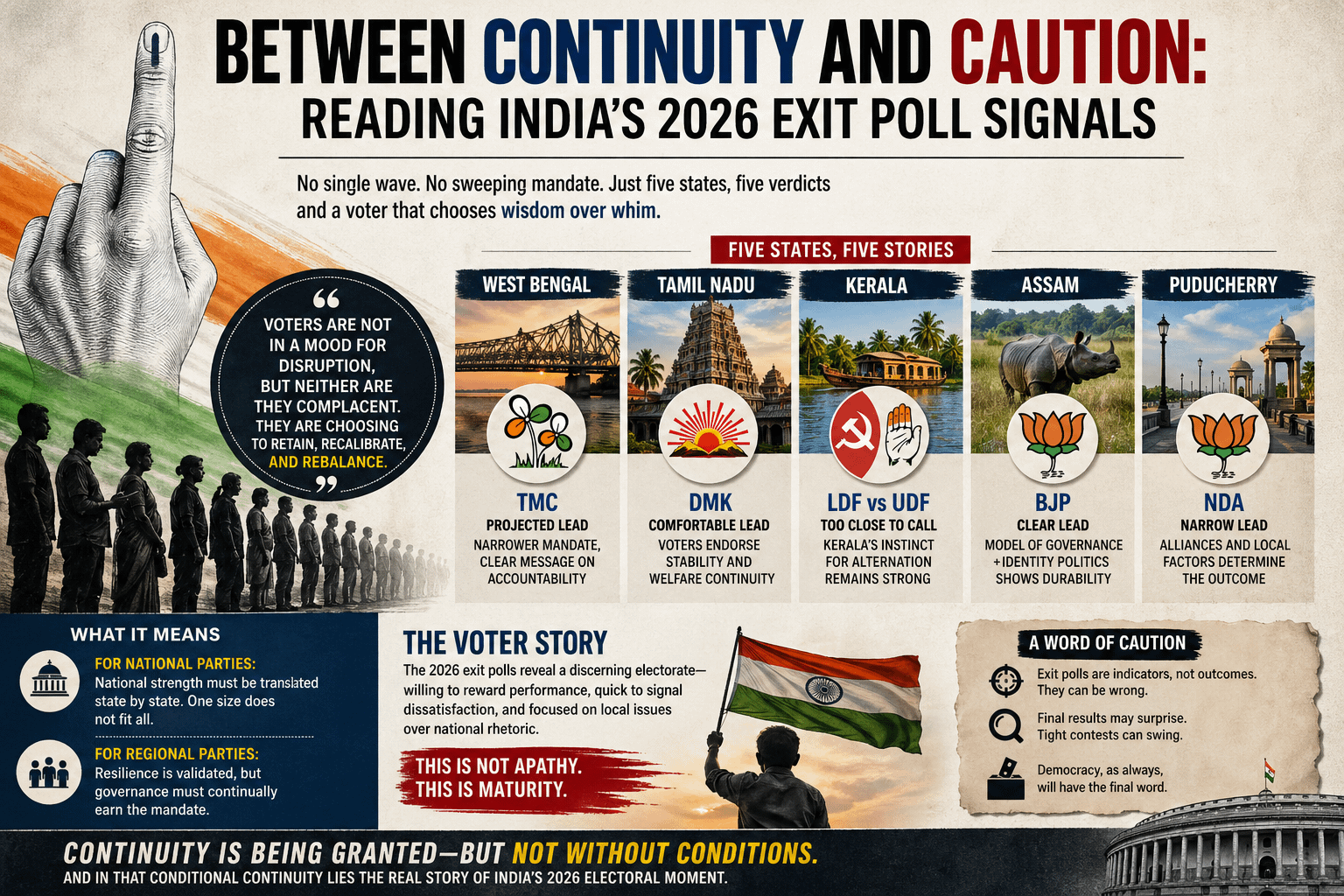
There is no sweeping wave cutting across regions, no singular narrative flattening diverse political landscapes. Instead, what we see is a set of state-specific verdicts, each shaped by its own political grammar, leadership dynamics, and governance record. The Indian voter, it appears, is neither in a mood for disruption nor complacency. The instinct is more measured—retain, recalibrate, and, where necessary, rebalance.
In West Bengal, the projected return of the All India Trinamool Congress under Mamata Banerjee—albeit with a narrower margin—captures this duality. The mandate is not a rejection; it is a reminder. Welfare delivery, grassroots organisation, and political identity continue to anchor the TMC’s appeal. Yet the shrinking margins suggest that sections of the electorate are signalling fatigue, or at least a desire for tighter accountability. For the Bharatiya Janata Party, the takeaway is equally nuanced: expansion has been sustained, but the leap to power remains elusive.
Tamil Nadu tells a steadier story. The Dravida Munnetra Kazhagam, led by M. K. Stalin, appears poised to return with relative comfort. Here, the electorate seems to have endorsed continuity more decisively. Governance stability, welfare continuity, and the absence of a cohesive opposition have combined to reinforce the incumbent’s position. Yet even in this apparent calm, there are undercurrents—the emergence of new political actors and the reconfiguration of opposition space—that could shape future contests.
If there is one state that resists the continuity narrative, it is Kerala. The exit polls point to a contest on a knife-edge, with the Left Democratic Front led by Pinarayi Vijayan facing a resurgent Congress-led UDF. Kerala’s political culture has long been defined by alternation, and the current projections suggest that this instinct remains alive. Even a marginal swing could tip the balance, making Kerala the most volatile—and therefore most revealing—arena in this election cycle.
In Assam, the picture is one of consolidation. The projected return of the BJP under Himanta Biswa Sarma underscores the durability of a model that blends governance delivery with identity politics. Assam’s verdict, if it holds, suggests that once a political formation embeds itself deeply within the state’s socio-political fabric, it can withstand both opposition challenges and the natural churn of incumbency.
Meanwhile, Puducherry remains a reminder that not all elections are driven by grand narratives. Here, margins are thin, alliances are decisive, and outcomes are shaped by localised factors that often defy broader trends. It is in such spaces that the complexity of Indian democracy is most visible.
Taken together, these projections point to a larger shift in the nature of electoral politics in India. The era of sweeping mandates—of waves that carry parties across states—appears to be giving way to an era of granular verdicts. Voters are no longer responding uniformly to national narratives; they are engaging with politics at a more local, more specific level.
This has significant implications for both national and regional parties.
For national parties, particularly the BJP, the challenge is one of translation. Strength at the national level does not automatically translate into state-level dominance. Each state demands its own strategy, leadership, and narrative. Where that translation is effective, as in Assam, the results follow. Where it is partial, as in Bengal, the ceiling becomes visible.
For regional parties, the message is one of validation—but also vigilance. The resilience of the TMC and the DMK underscores the enduring relevance of state-based political formations. Yet the narrowing margins in some states suggest that this resilience cannot be taken for granted. Governance must continually justify political dominance.
Perhaps the most important story, however, is about the voter.
The 2026 exit polls suggest an electorate that is increasingly discerning. Voters are willing to reward performance, but they are equally willing to signal dissatisfaction. They are not easily swept up by rhetoric, nor are they entirely resistant to change. Instead, they are exercising a form of political judgment that is incremental rather than absolute.
This is not apathy; it is maturity.
Of course, exit polls are not outcomes. They are indicators, subject to error, bias, and the inherent unpredictability of democratic behaviour. The final results may well surprise—tight contests may open up, projected leads may narrow, and unexpected outcomes may emerge.
But even with that caveat, the broad contours are instructive.
India, it seems, is entering a phase where elections are less about dramatic shifts and more about measured adjustments. Governments are not easily overturned, but neither are they unconditionally endorsed. Power is retained—but on terms set by the voter.
Continuity, in other words, is being granted—but not without conditions.
And in that conditional continuity lies the real story of India’s 2026 electoral moment.
Tamil Nadu (234 seats)
Exit Poll Range
- DMK+: 150 – 170
- AIADMK+: 55 – 75
- Others: 5 – 15
Latest Update
- Strong convergence across agencies
- DMK projected to cross majority comfortably
👉 Verdict: DMK landslide / comfortable return
Kerala (140 seats)
Exit Poll Range
- LDF: 65 – 75
- UDF: 65 – 75
- Others: 0 – 3
Latest Update
- Several exit polls show near tie or marginal lead either way
- Some projections hint at UDF comeback, others LDF hold
👉 Verdict: Photo finish (tightest race in India)
Assam (126 seats)
Exit Poll Range
- BJP+ (NDA): 80 – 100
- Congress+: 25 – 45
- Others: 0 – 5
Latest Update
- Strong agreement across agencies
- BJP expected to retain power comfortably
👉 Verdict: Clear BJP win
Puducherry (30 seats)
Exit Poll Range
- NDA: 16 – 19
- Congress+: 10 – 14
- Others: 0 – 2
Latest Update
- NDA projected to retain government
- Youth vote shifts (TVK factor) noted but not decisive
👉 Verdict: NDA edge
West Bengal (294 seats)
Exit Poll Range (Mixed Agencies)
- TMC: 170 – 210
- BJP: 90 – 170
- Left+Congress: 0 – 15
Latest Update
- Some exit polls show TMC retaining power
- Others suggest a possible BJP upset or neck-and-neck race
👉 Verdict: Too close / highly volatile