

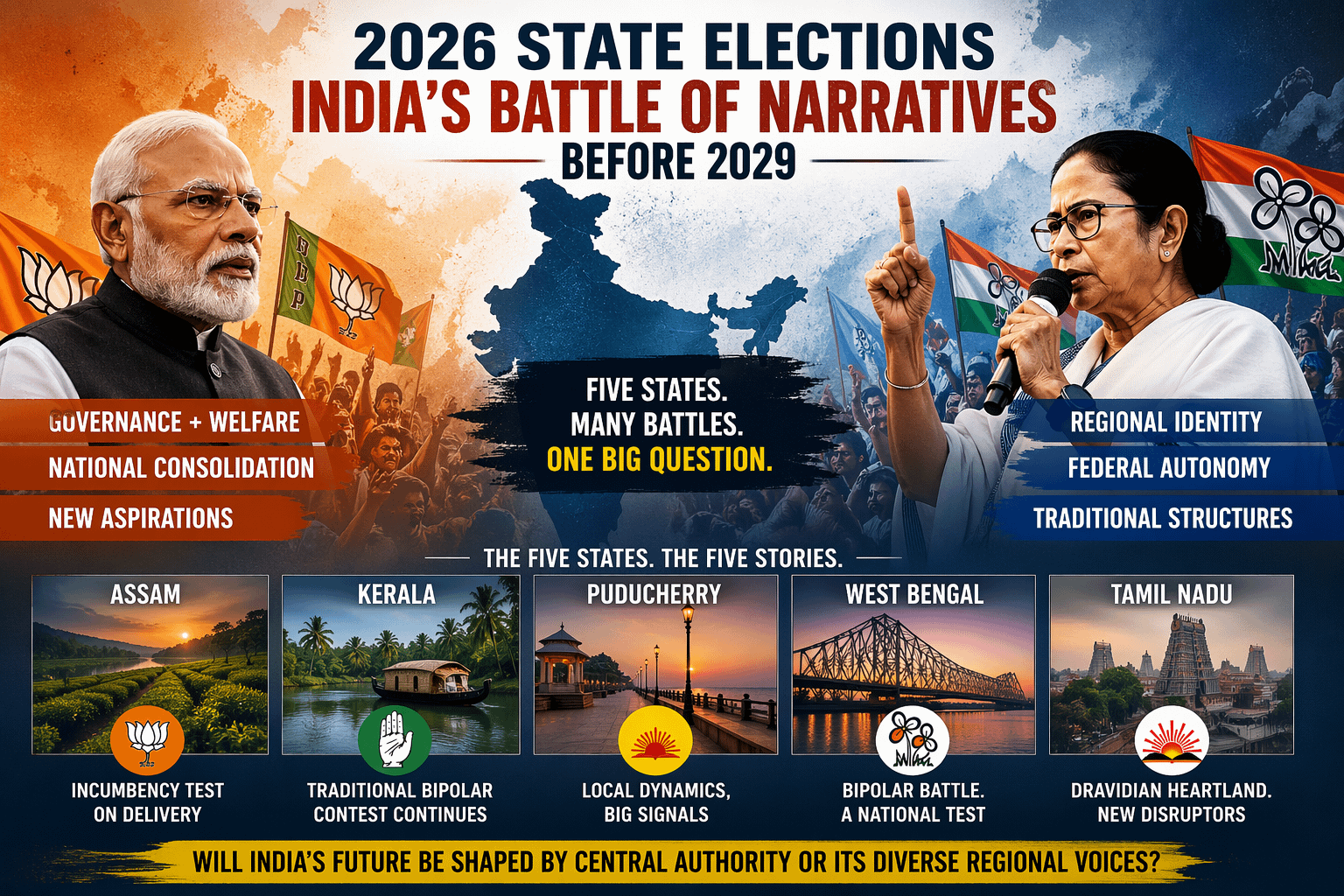
The 2026 state elections reflect a deeper churn in Indian politics. These high-stakes elections have redrawn battle lines between the ruling party and the opposition, as the intensifying conflict pivots around the common planks of welfare versus governance, regional identity versus national consolidation and old political structures versus evolving voter aspirations.
While elections in Assam, Kerala, and Puducherry have concluded, West Bengal and Tamil Nadu—two politically and culturally distinct states—are yet to go to the polls.
West Bengal: The Epicentre of Political Polarisation
West Bengal, which goes to the polls in two phases, has beaten anti-incumbency for four consecutive years. It is one of the few states that has taken on the Modi-BJP-led juggernaut for over a decade, and has voted for Mamata Banerjee-led TMC, the regional ‘tigress’, who had taken over from the longest-serving CPM government in any state in India. The battleground, therefore, is increasingly bipolar between the BJP and the Trinamool Congress (TMC) despite the presence of the Congress and its allies. This 2026 election, however, would draw on from Special Intensive Revision (SIR) exercise, which added nearly seven lakh new voters, ahead of the polling. Whether the SIR would challenge the 2021 popular verdict that went the TMC way while delivering a decent number of seats to the BJP, a relatively new entrant in the CPM-TMC vote bank, is a billion-dollar question!
While the BJP’s plank propels a governance-plus-welfare narrative, the TMC’s defence is tied to Bengal’s identity and federal autonomy. The contest is largely bipolar between the state mammoth TMC and the BJP, which emerged as the main opposition party after 2021 elections, winning 77 seats in the TMC turf.
What makes Bengal important is not just the outcome, but the signal it sends off: can the BJP decisively take over from a strong regional fortress, or will regional resilience prevail?
Tamil Nadu: A New Political Layer Emerges
On the other side, Tamil Nadu faces a more nuanced political shift. While the DMK versus AIADMK-led NDA contest is central to the Dravidian state, the entry of actor Vijay’s party TVK has offered a new alternative—youth-driven political disruption tightening the fight between the two Dravidian parties, with the BJP making in-roads in alliance with the AIADMK.
As much as the DMK’s recent urban-focused initiatives centring around infrastructure, employment and aspirational governance, opposition forces are attempting to consolidate anti-incumbency sentiment.
This election isn’t just about regular electoral victory, but whether Dravidian politics can hold on to much younger, more urban and politically fluid electorate.
Kerala and Assam: Stability Meets Performance Test
Kerala, where the voting has just concluded, the traditional LDF–UDF bipolar contest continues to dominate the political landscape. On the flip side, the BJP, which bagged only one seat in 2016 and made no gain in 2021, has fielded candidates from every single constituency. The focus of the saffron party is more on expanding its footprint rather than just making electoral gains.
Assam presents a different dynamic. The BJP faces an incumbency test rooted in governance performance rather than ideological contestation. Infrastructure, law and order and regional identity dominate the discourse, making this election more of a referendum on delivery than promises.
Puducherry: Small Territory, Big Signals
Often overlooked, Puducherry reflects the growing fragmentation of Indian politics at the grassroots level. High voter participation and a competitive multi-party environment indicate that local dynamics and independent candidates are gaining relevance. This subtle trend could shape future electoral patterns in larger states.
The Larger Trends: A Political System in Transition
Across all five elections, four key trends stand out. First, welfare politics is evolving. It is no longer just about broad subsidies, but targeted benefits aimed at specific voter groups—especially women and youth. Second, the urban voter is gaining influence. City-centric manifestos and infrastructure-driven promises signal a shift towards aspirational politics. Third, youth participation is reshaping outcomes. New political entrants and higher engagement levels point to a generational shift in voter behaviour.
Finally, and most significantly, is the tension between federalism and centralisation. Regional parties are framing these elections as a defence of state autonomy, while national parties are advancing a more unified governance narrative.
Conclusion: More Than State Elections
The 2026 assembly elections are not just about forming governments—they are about defining India’s political trajectory. They will determine whether national dominance expands, whether regional strongholds endure, and whether new political forces can disrupt established equations.
As the country moves towards the 2029 general elections, these contests offer an early answer to a critical question:
Will India’s political future be shaped more by central authority or by its diverse regional voices?
The results may arrive on May 4—but their implications will resonate far beyond.