| By Manish Kumar Pandey and Susmita Mitra
Building Viksit Bharat through Community Action
India is investing at an unprecedented scale in ports, maritime connectivity, manufacturing and the Blue Economy as part of its vision of Viksit Bharat 2047. As coastal economies expand, there is also an opportunity to strengthen the natural systems that sustain them. Healthy reefs, sand dunes, wetlands and seagrass beds – protect shorelines, support fisheries, reduce disaster risks and underpin millions of livelihoods. Together, they enhance the long-term resilience and sustainability of India’s coastal development.
Across India’s coastline, local communities are already helping realise this vision by restoring these natural assets. Their experience demonstrates how community stewardship can complement national investments while offering practical models for replication and scaling.
Under the Global Environment Facility Small Grants Programme (GEF-SGP)—executed by the Ministry of Environment, Forest and Climate Change (MoEF&CC), implemented by the United Nations Development Programme (UNDP) and nationally hosted by TERI—community organisations including PLANT Trust, M. S. Swaminathan Research Foundation (MSSRF), Arulagam and Amrita Vishwa Vidyapeetham are translating national priorities into measurable ecological, social and economic outcomes. Their experience demonstrates that relatively modest investments in communities can generate multiple returns for people, nature and the economy.
Community-led Restoration by the Numbers
| Indicator | Achievement | Why it matters |
| Beneficiaries reached | 7,476 people | Stronger livelihoods and community stewardship |
| Marine habitat under improved practices | 723 ha | Supports fisheries and the Blue Economy |
| Land restored | 52 ha | Strengthens coastal resilience |
| Women trained | 100 | Expands green livelihood opportunities |
| Women entrepreneurs | 10 | Promotes circular economy enterprises |
| Fishing families benefiting | 1,200 | Higher and more secure incomes |
| Nature-based innovations | 4 proven models | Ready for replication and scaling |
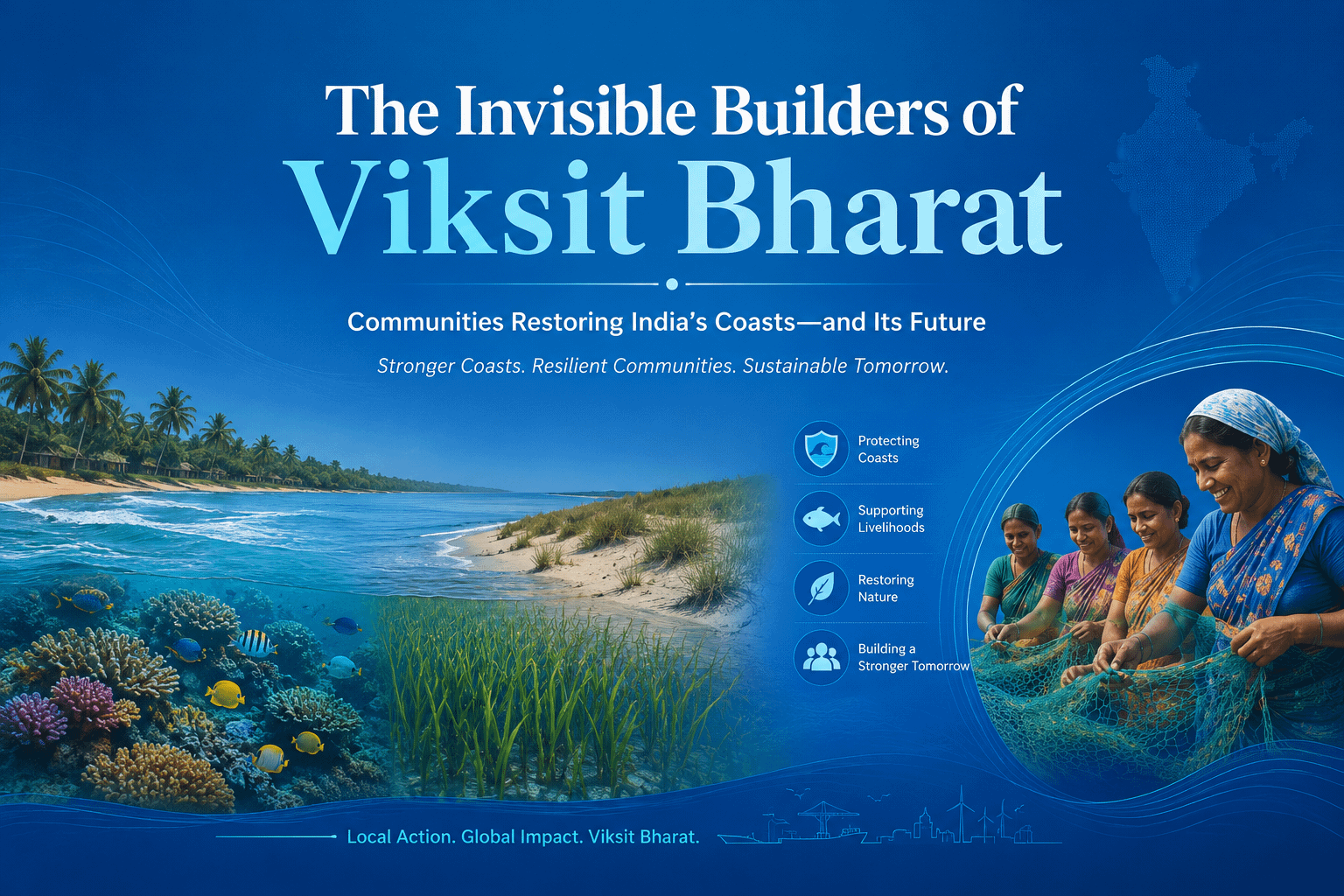
The numbers tell only part of the story. Across Tamil Nadu’s coastline, communities are demonstrating how innovation begins with local knowledge. Artificial reefs are reviving fish habitats, restored sand dunes are protecting villages from storms, ghost fishing gear is being transformed into marketable products, and women-led seaweed cultivation is creating new livelihood opportunities while reducing pressure on marine resources.
One woman from Ramanathapuram captured this transformation best. What she once saw as discarded fishing nets has become both a source of income and a way to protect the sea for future generations. Her story reflects a broader shift taking place along India’s coast: communities are not simply adopting new ideas—they are creating locally relevant innovations that restore ecosystems, strengthen livelihoods and inspire solutions that can be replicated far beyond their villages.
A Development Model for Viksit Bharat
The vision of Viksit Bharat 2047 calls for development that is economically strong, environmentally resilient and socially inclusive. The experiences emerging from India’s coastline show how local communities can contribute to this vision.
Across these initiatives, fishers contribute generations of ecological knowledge. Women lead self-help groups and green enterprises. Young people participate in restoration and monitoring, while researchers, local governments and community institutions provide scientific guidance and long-term stewardship. Together, these partnerships demonstrate that community participation, local innovation and science can reinforce one another to create lasting ecological, economic and social benefits.
The lessons extend well beyond the coastline. Healthy ecosystems support fisheries and tourism, reduce disaster risks and create sustainable livelihoods. Community-led restoration also advances several of India’s national priorities by strengthening the Blue Economy, promoting sustainable lifestyles under Mission LiFE, and contributing to India’s commitments under the Kunming–Montreal Global Biodiversity Framework (KMGBF). Investing in healthy ecosystems alongside physical infrastructure enhances the long-term resilience and sustainability of development.
The most important lesson, however, is that these are not isolated success stories. Together, they reveal a practical model that can be adapted across India’s diverse landscapes—from mangroves and wetlands to river basins, forests and drylands.
A Six-Pillar Model for Scaling Community-led Restoration
- Community ownership with local leadership and stewardship.
- Science combined with traditional ecological knowledge.
- Livelihood-centred restoration that creates economic opportunities.
- Women’s leadership as entrepreneurs and decision-makers.
- Partnerships among government, research institutions, civil society and communities.
- Continuous learning, monitoring and scaling to replicate successful innovations.
These six pillars offer a practical blueprint for integrating community-led restoration into India’s broader development journey.
The Invisible Builders of Viksit Bharat
India’s progress towards Viksit Bharat 2047 is being driven by visionary investments in infrastructure, manufacturing and the Blue Economy. Alongside these efforts, coastal communities are restoring the ecosystems that protect lives, secure livelihoods and strengthen climate resilience.
The invisible builders of Viksit Bharat are already at work. Their experience shows that when national vision is complemented by community leadership, local innovation and healthy ecosystems, development becomes more resilient, inclusive and sustainable. As India builds the foundations of a developed nation, these local innovations offer a scalable pathway for ensuring that growth is not only faster, but also greener, more resilient and more inclusive.
Mr. Manish Kumar Pandey, National Coordinator, GEF Small Grants Programme (SGP) India, TERI, New Delhi; Dr. Susmita Mitra, Knowledge Partner, GEF-SGP India, Council for Social Development (CSD), New Delhi. The views expressed are personal.