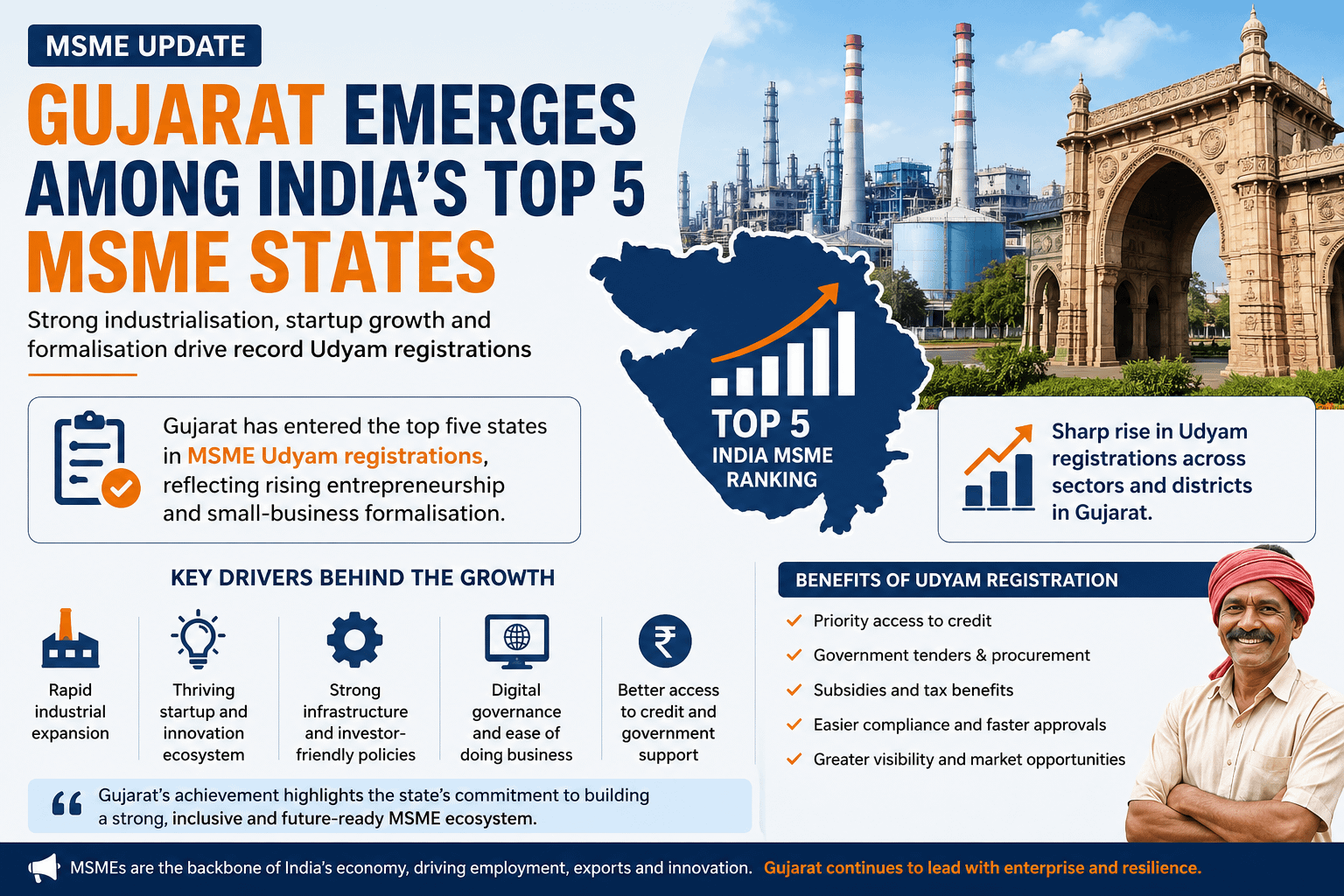
Gujarat has emerged among India’s top five states in MSME Udyam registrations, underlining the state’s accelerating industrial growth, expanding entrepreneurial ecosystem, and increasing formalisation of small businesses. The development is being viewed as a significant indicator of Gujarat’s strengthening position in India’s manufacturing and startup economy.
According to a news report in Times of India, which citated official data presented by the Gujarat government, the state recorded a sharp rise in registrations under the Udyam portal — the Union Government’s digital registration platform for Micro, Small and Medium Enterprises (MSMEs). The increase reflects growing participation by small businesses in the formal economy and wider adoption of government-backed financial and policy support systems.
The Udyam Registration system, introduced by the Ministry of MSME, enables enterprises to access multiple benefits, including priority lending, government procurement opportunities, subsidies, tax incentives, and easier compliance procedures. Registration has increasingly become essential for businesses seeking integration into formal supply chains and institutional financing networks.
Officials attribute Gujarat’s rise to a combination of industrial expansion, strong infrastructure, investor-friendly policies, and the rapid growth of startup and manufacturing clusters across cities such as Ahmedabad, Surat, Rajkot, and Vadodara. The state has seen significant growth in sectors including textiles, chemicals, pharmaceuticals, engineering goods, gems and jewellery, food processing, renewable energy, and auto components.
Government sources said Gujarat’s MSME ecosystem has benefited from improved digital governance, industrial corridor development, logistics connectivity, and easier access to credit through state-backed facilitation programmes. Officials also highlighted increasing awareness among small entrepreneurs regarding the advantages of formal registration and participation in digital marketplaces.
The growth in Udyam registrations also reflects a broader national trend toward formalisation following GST implementation, digital payment adoption, and expansion of government-linked procurement systems such as the Government e-Marketplace (GeM). Analysts note that formal registration improves the visibility of small enterprises in the banking system, enabling better access to working capital and institutional support.
Industry experts believe Gujarat’s performance reinforces its position as one of India’s most business-oriented states. Economists say the state’s manufacturing culture, export orientation, and industrial infrastructure have helped create a conducive environment for micro and small enterprises. Many MSMEs in Gujarat operate as suppliers to larger domestic and global manufacturing chains, particularly in chemicals, textiles, engineering, and diamond processing.
At the same time, experts caution that rapid registration growth must translate into sustainable enterprise development. Rising raw material costs, energy expenses, global demand fluctuations, and delayed payments remain major challenges for MSMEs across the country, including Gujarat.
The Union Government has increasingly positioned MSMEs at the centre of India’s economic strategy, particularly under initiatives such as “Make in India,” “Digital India,” and the ₹10,000 crore SME Growth Fund announced in the Union Budget 2026–27. Policymakers view formalised MSMEs as critical to employment generation, export growth, and India’s ambition to become a global manufacturing hub.
Perspective
Gujarat’s emergence among the top MSME registration states is not merely a statistical achievement — it reflects the changing structure of India’s small-business economy. Formalisation is no longer optional; it is becoming the gateway to survival, finance, and growth. Yet the larger question remains whether registration alone can guarantee resilience. For India’s MSMEs, the real test lies beyond paperwork — in sustaining profitability, innovation, and competitiveness amid an increasingly volatile economic landscape.