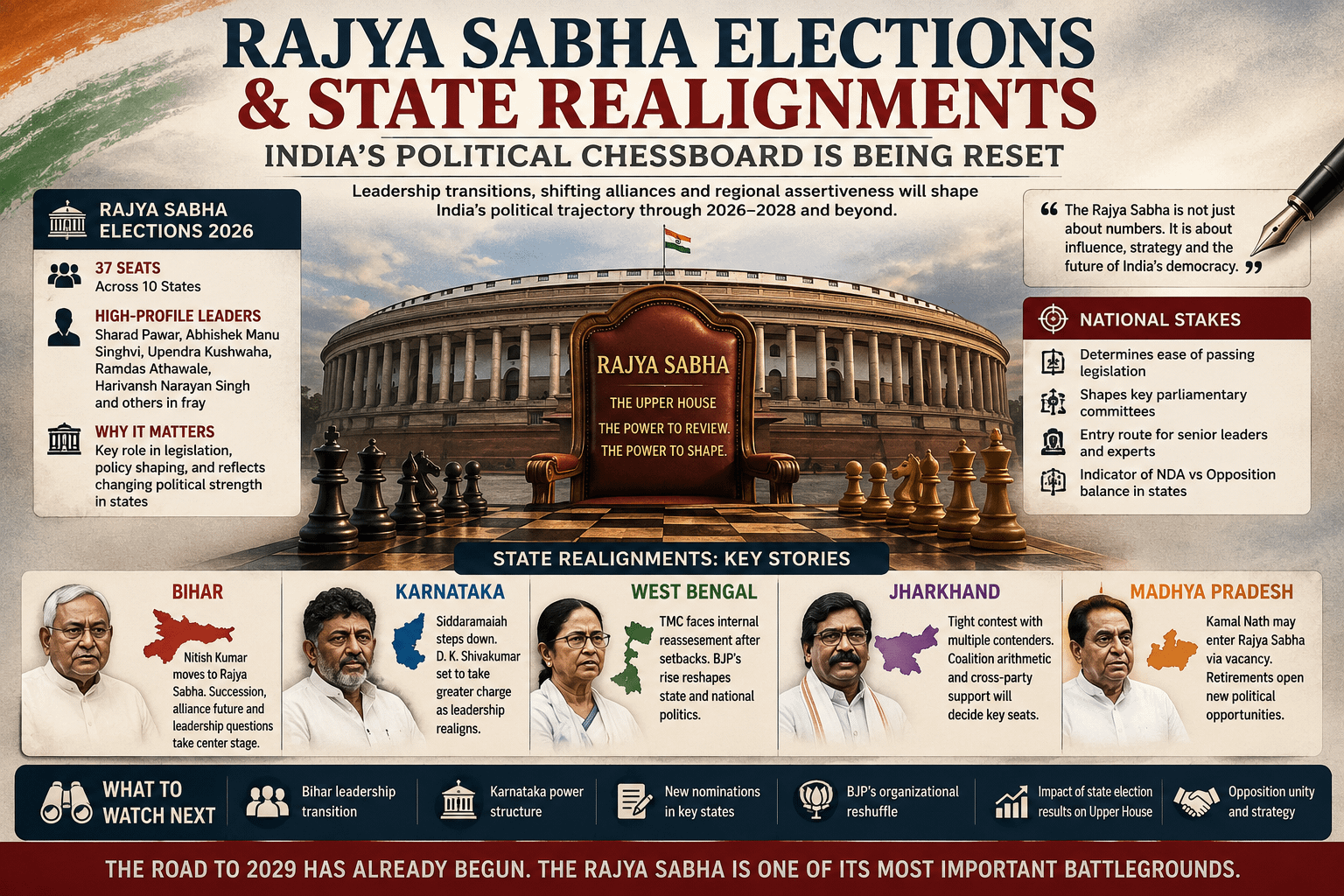

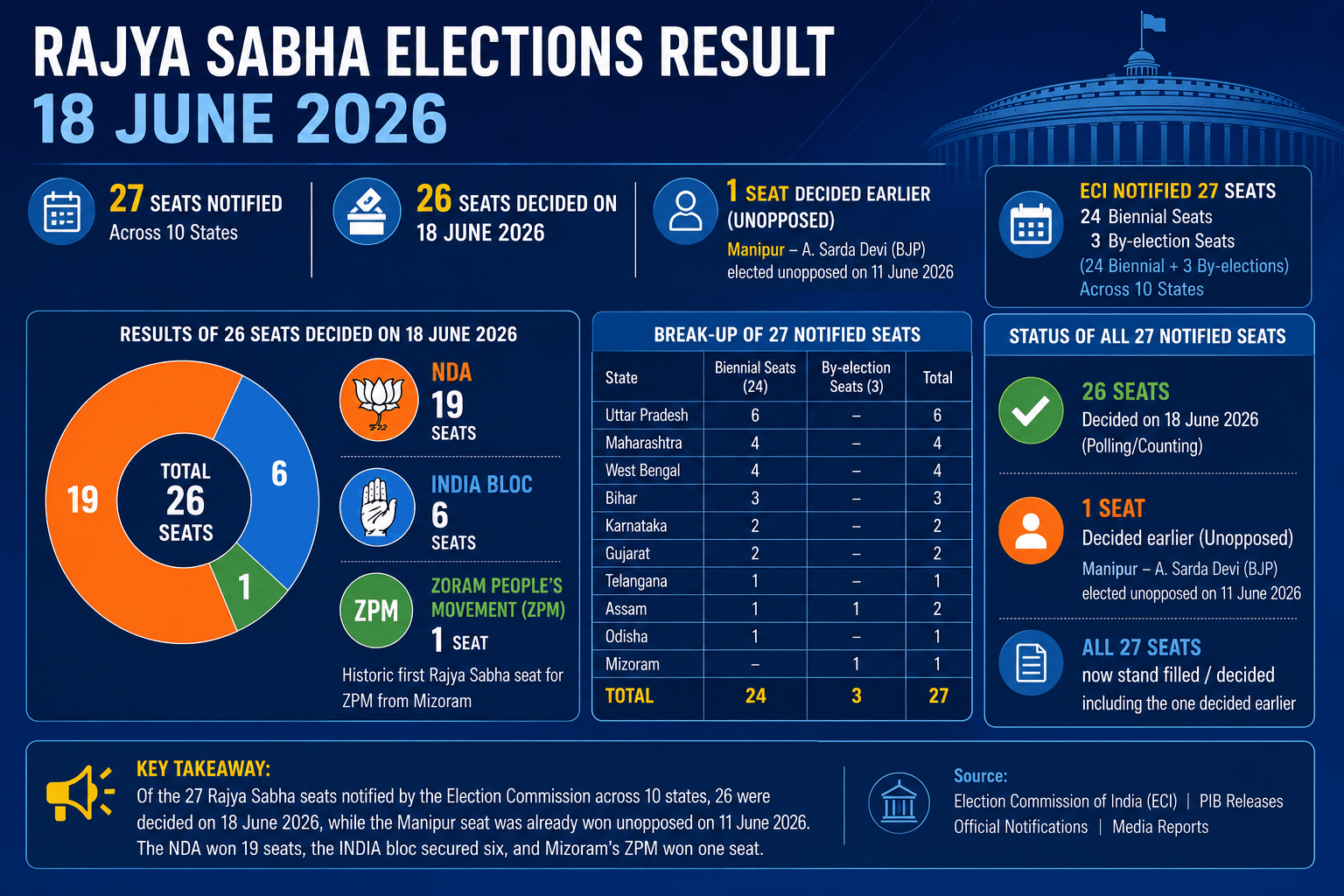
In the recently held Rajya Sabha elections on June 18, 2026, the BJP-led National Democratic Alliance (NDA) bagged 19 of 26 seats which pushed its effective strength to 150 seats, 13 short of the 163-member benchmark required for a two-thirds majority in the 245-member Upper House.
The Congress-led INDIA bloc won six seats, while the ruling Zoram People’s Movement (ZPM) secured Mizoram’s lone seat, marking its first-ever representation in the Rajya Sabha.
The Election Commission of India (ECI) had earlier notified elections to 27 seats, comprising 24 biennial vacancies and three by-elections, necessitated by the retirement of incumbent members and vacancies created by members vacating their seats before completing their terms.
Jharkhand Delivers Biggest Surprise
The most closely watched contest unfolded in Jharkhand, where NDA-backed Independent candidate Parimal Nathwani defeated Congress nominee Pranav Jha amid allegations of cross-voting within the INDIA bloc. Meanwhile, JMM candidate Baidyanath (Baijnath) Ram secured the state’s second seat.
The result exposed fault lines within the opposition alliance, with Congress reportedly blaming some allies for the setback.
NDA’s Position Strengthens
According to post-election calculations, the NDA’s strength in the Rajya Sabha stands at 150 members, leaving it approximately 13 seats short of the two-thirds threshold of 163 seats in the 245-member House.
BJP Emerges Stronger
The BJP itself has strengthened its numerical position in the Upper House over recent months. Separate developments, including mergers and shifting alliances, have also altered the parliamentary arithmetic.
While the NDA is within striking distance of a two-thirds majority in the Rajya Sabha, it remains dependent on support from regional parties and nominated members for key legislative initiatives. Constitutional amendments would still require the requisite support in both Houses of Parliament and, in some cases, ratification by at least half of the state legislatures.
Role of Nominated Members
The Rajya Sabha currently comprises 233 elected members and 12 nominated members, who are appointed by the President under Article 80 of the Constitution from fields such as literature, science, art and social service.
These 12 members can vote on ordinary legislation and in the Vice-Presidential election, though they do not participate in the election of the President of India.
Looking Ahead
Political analysts say the latest gains will strengthen the NDA’s ability to manage legislative business in the Upper House. However, the coalition is unlikely to achieve an independent two-thirds majority immediately and will continue to rely on issue-based support from smaller regional parties.
Editor’s Note: Exact party-wise numbers in the Rajya Sabha remain dynamic and are subject to changes arising from vacancies, by-elections, resignations, mergers and fresh nominations. Figures reported above are based on post-election estimates published on June 19, 2026, and should be cross-verified against the official Rajya Sabha Secretariat records once updated.