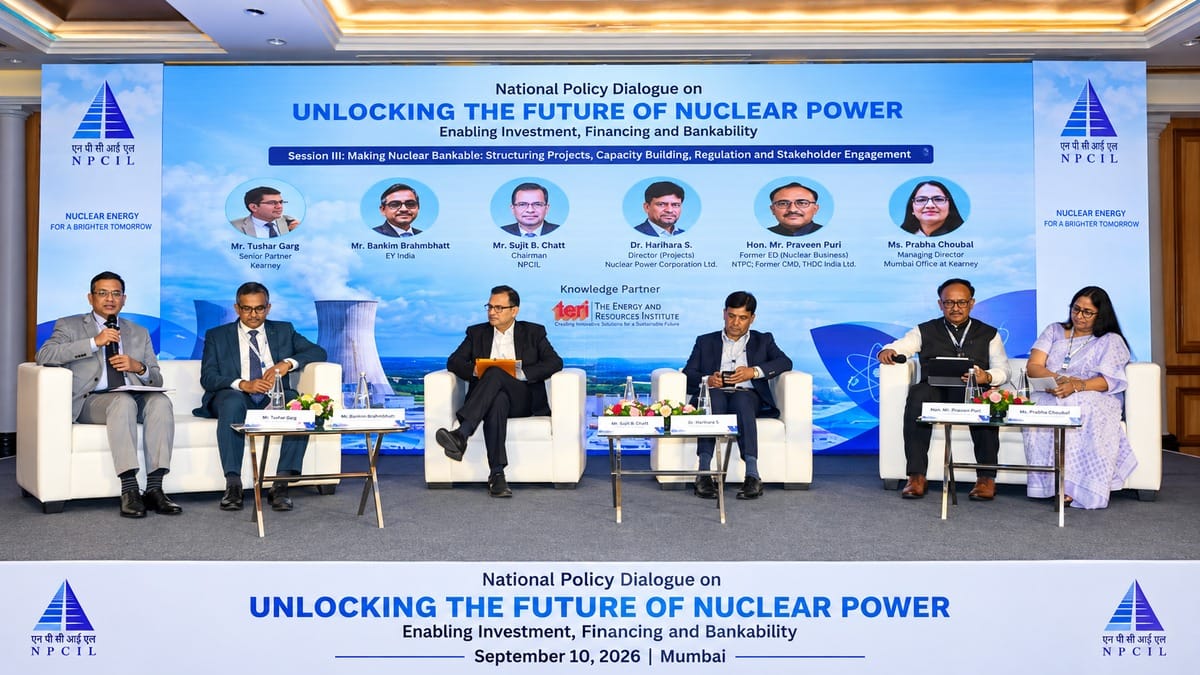
MUMBAI, Sept. 11, 2026 /debcubspark.com-DigiTIMES./ — India Infrastructure Finance Company Limited (IIFCL), a wholly-owned Government of India enterprise under the Ministry of Finance, convened a National Policy Dialogue on “Unlocking the Future of Nuclear Power: Enabling Investment, Financing and Bankability” at the Hilton Mumbai International Airport, Mumbai on Sept. 11, 2026, with The Energy and Resources Institute (TERI) as knowledge partner, bringing together senior policymakers, nuclear-sector experts, financial institutions, developers, and industry leaders to deliberate on the pathways for scaling up nuclear power in India.
The dialogue focused on the financial, regulatory and institutional conditions necessary to attract greater investment into nuclear energy and develop projects that can secure long-term financing.
The discussions brought together representatives from the Department of Atomic Energy, Ministry of Finance, public financial institutions, banks, infrastructure financiers, nuclear-sector developers and industry, reflecting the growing convergence between energy policy and financial-sector stakeholders on the future of nuclear power in India.
In his welcome address, Mr Palash Srivastava, Deputy Managing Director, IIFCL, emphasised the importance of creating an enabling financing ecosystem to support the development and expansion of nuclear power in India.
Delivering the Special Address, Mr K. Ramanathan, Distinguished Fellow Emeritus, TERI, highlighted the strategic role of nuclear power in India’s energy transition and the Government’s target of 100 GW of nuclear capacity by 2047.
Setting the context for the deliberations, Mr Rohit Rishi, Managing Director, IIFCL, highlighted the need to significantly scale up nuclear power as India’s energy requirements grow. Noting that nuclear contributes around 18% of the electricity mix in Russia and the US and nearly 60% in France, compared with around 3% in India, he emphasised that achieving India’s 100 GW nuclear capacity target by 2047 would require greater private-sector participation and access to long-term capital.
As the Chief Guest, Mr S. A. Bhardwaj, Former Interim CMD NPCIL, Former Chairman, Nuclear Fuel Complex Board, and Former Chairman, Atomic Energy Regulatory Board (AERB), delivered the keynote Address, providing insights into the evolution of India’s nuclear power programme and the requirements for its next phase of development. Reflecting on India’s experience in developing and operating indigenous reactor technologies, he emphasised the importance of building on the knowledge and capabilities accumulated through these projects and moving from first-of-a-kind (FOAK) to nth-of-a-kind (NOAK) deployment. He noted that greater deployment of proven reactor technologies, supported by appropriate risk-sharing and profit-sharing mechanisms, could create a win-win proposition by reducing project and financing risks while enabling wider participation of private capital and industry in India’s nuclear expansion.”
Mr Manoj Muttathil Ayyappan, Joint Secretary, Department of Financial Services, Ministry of Finance, Government of India, provided the policy and financing perspective on the emerging requirements of the nuclear sector in his special address. He emphasised that the nuclear power discourse extends beyond energy to long-term economic resilience, clean growth and strategic self-reliance, and highlighted the need for an appropriate financial architecture to support the next generation of infrastructure.
The first session, “Developers’ Perspective – Enabling Investment in Nuclear Energy”, examined the evolving landscape for private investment in India’s nuclear power programme. Moderated by Mr A.K. Saxena, Senior Director, TERI, the session brought together senior representatives from the Department of Atomic Energy, Westinghouse India, Jindal India Power and the Bajaj Group to discuss the conditions required to enable greater participation by developers and investors.
The deliberations focused on policy and regulatory certainty, allocation of project and technology risks, financing and project development structures, and the respective roles of public and private-sector stakeholders. The discussion also highlighted the importance of building greater confidence among developers and financiers through predictable frameworks, appropriate risk-sharing mechanisms and a stronger domestic ecosystem for nuclear projects.
The second session, “Financing Nuclear Energy – Perspectives of Financial Institutions”, examined the financing requirements of India’s expanding nuclear power programme and the challenges involved in mobilising long-term capital for nuclear projects.
Following a presentation by Prof. Ravi Madhavan, School of Business, University of Pittsburgh, the session, moderated by Mr Raj Kumar Ralhan, Chief Credit Officer, IIFCL, brought together senior representatives from the Department of Atomic Energy, NaBFID, PFC, NPCIL and Axis Bank.
The discussion focused on project finance structures, risk mitigation, long-tenor financing and the need for greater familiarity with the unique characteristics of nuclear projects within the financial sector. The panel also deliberated on the evolving nuclear ecosystem and the importance of developing financing frameworks that appropriately address the long gestation periods, technology and construction risks, and other project-specific considerations associated with nuclear assets.
The third session, “Making Nuclear Bankable,” examined the key risks and enabling conditions that will determine the bankability of nuclear power projects in India. Moderated by Mr Salil Garg, Chief Strategy Officer, IIFCL, the session brought together perspectives from financing, regulation, project development, technology and insurance.
The discussion highlighted project execution, regulatory capacity, domestic manufacturing, skilled manpower, insurance and financing risks as important considerations for scaling up nuclear power. The panel emphasised the need to address project risks early, including interface management, vendor readiness, long-lead items and the availability of qualified manpower and manufacturing capacity.
The National Policy Dialogue provided a platform for policymakers, developers and financial institutions to exchange perspectives on the practical measures required to create a more predictable, investment-friendly and financeable environment for nuclear energy in India.
The dialogue concluded with a call for continued collaboration among government, industry and the financial sector to develop appropriate frameworks for investment, financing, and project bankability, supporting the responsible expansion of nuclear power as part of India’s long-term energy strategy.