
Dr Harish Yadav
The story of BRICS is no longer merely the story of five emerging economies seeking a larger voice in the international system. What began as an economic concept has gradually evolved into a broad platform for political dialogue, economic cooperation, development finance, technology, sustainability and people-to-people engagement. Its expansion across Asia, Africa, Latin America and the Middle East reflects a deeper transformation in the global economic and geopolitical landscape.
At the heart of this transformation is a fundamental question: Can the institutions of global governance adequately reflect the economic weight, aspirations and development priorities of the Global South?
BRICS has increasingly positioned itself as one of the platforms through which this question can be addressed.
From an Economic Acronym to a Global Platform
The acronym BRIC was coined in 2001 by Goldman Sachs to describe Brazil, Russia, India and China as economies with the potential to become major global economic powers. The concept subsequently acquired institutional form. BRIC became a political cooperation forum in 2006, held its first summit in Yekaterinburg in 2009, and expanded into BRICS with South Africa’s inclusion.
The grouping subsequently moved beyond its original economic orientation. Development, finance, health, climate action, technology, trade, agriculture and people-to-people cooperation became integral components of its agenda. The expansion accelerated in 2024, when Egypt, Ethiopia, Iran, Saudi Arabia and the UAE became full members, followed by Indonesia in 2025. The emergence of a Partner Country category has further widened BRICS’ outreach and created additional avenues for South-South cooperation. The result is a BRICS that is geographically broader, economically more diverse and politically more consequential than its original formulation.
The Weight of the Expanded BRICS
The significance of BRICS lies not merely in the number of countries participating but in the economic, demographic and geographical weight represented by the grouping. The material provided for India’s 2026 Presidency notes that the 11 full members collectively account for approximately 49.5% of the world’s population, 40% of global GDP and 26% of global trade. These figures demonstrate why BRICS has become an important forum for the Global South. It brings together major markets, natural resources, manufacturing capabilities, technological capacities and diverse development experiences.
The New Delhi Summit: A Moment of Institutional Consolidation
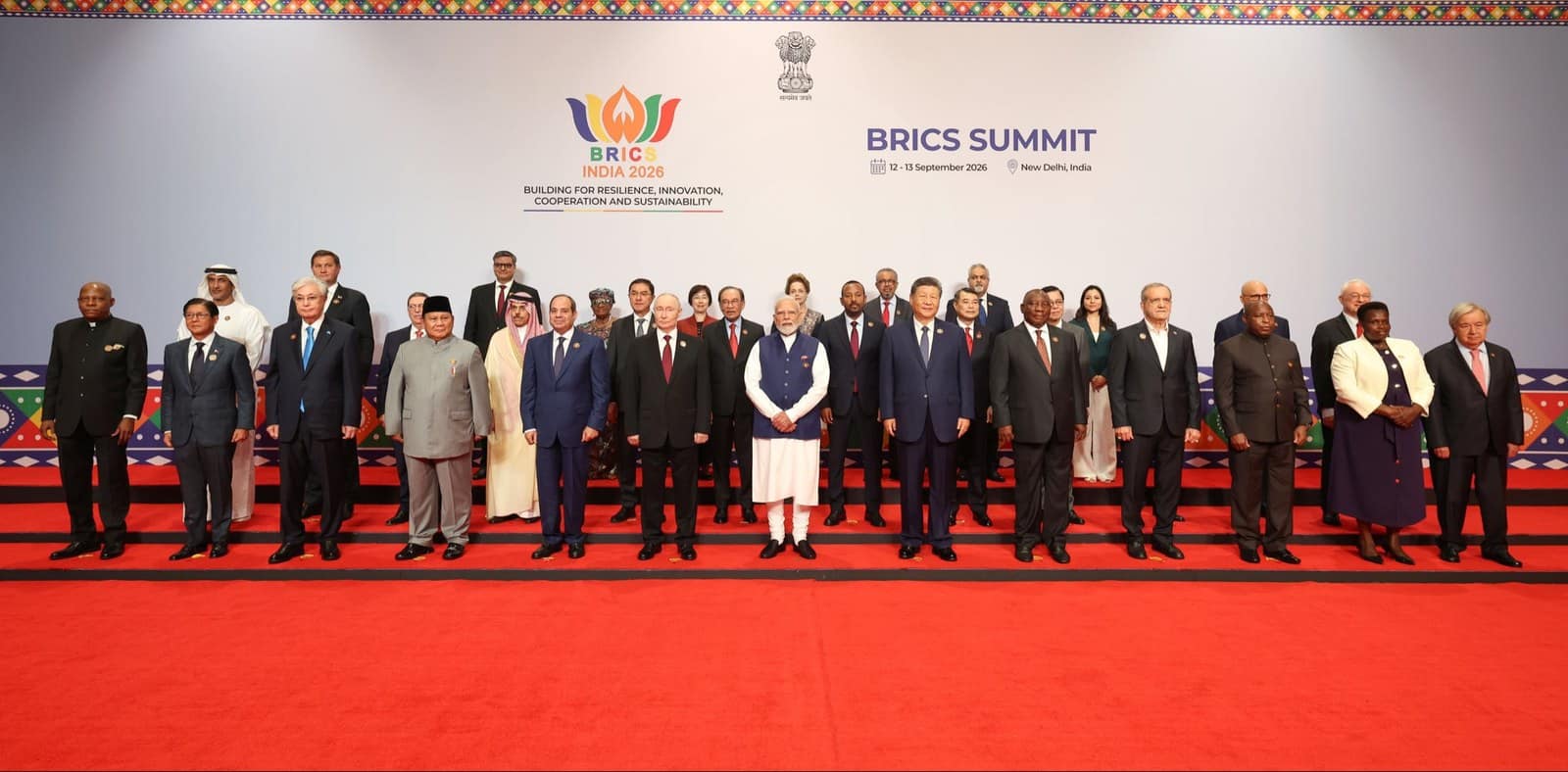
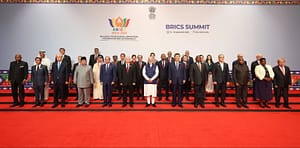
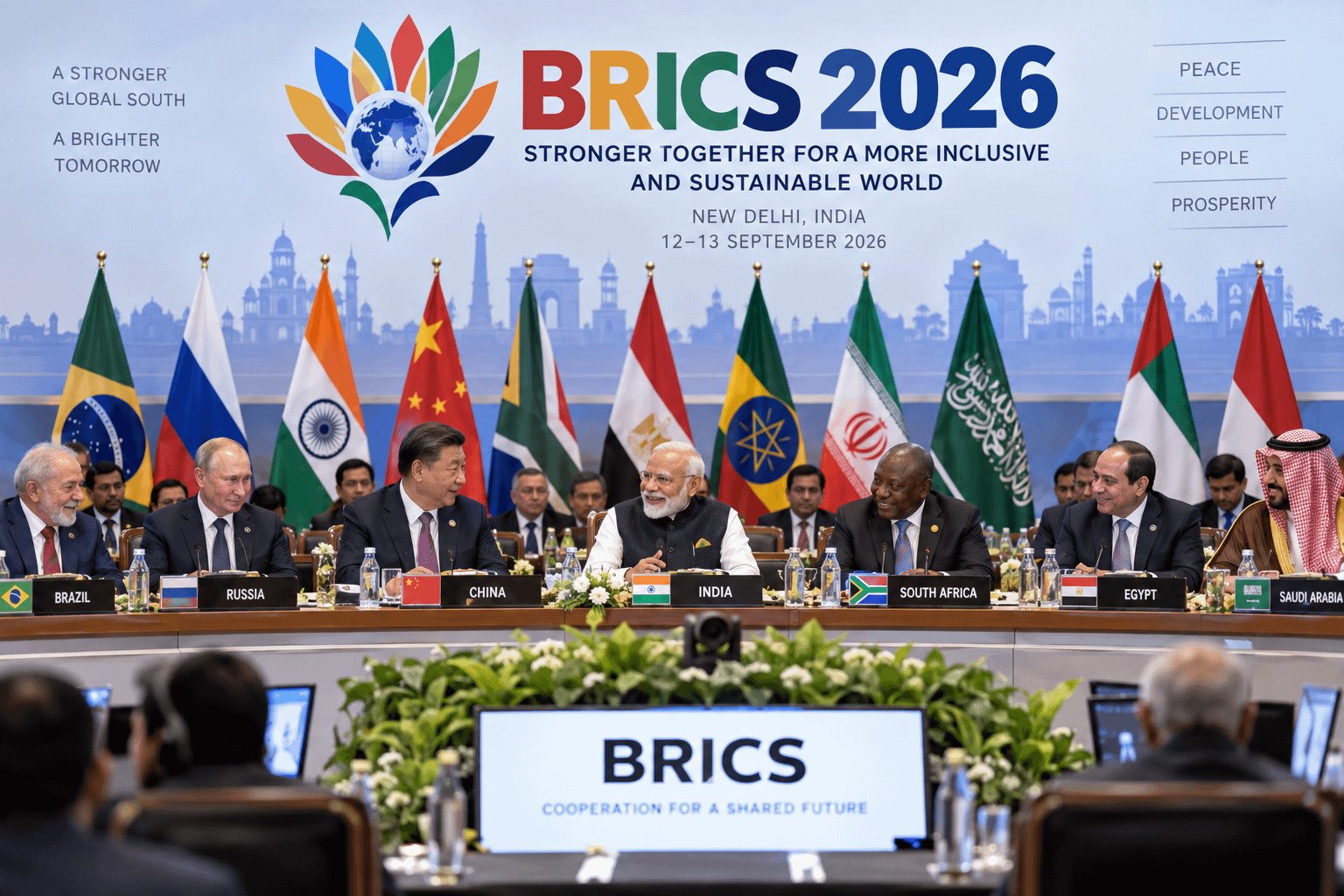
The 18th BRICS Summit was held in New Delhi on 12–13 September 2026 under India’s Presidency. The New Delhi Declaration reaffirmed the BRICS principles of sovereign equality, mutual respect, solidarity, openness, inclusiveness, collaboration and consensus.
The Declaration reaffirmed cooperation across three broad pillars:
- Political and security cooperation
- Economic and financial cooperation
- Cultural and people-to-people cooperation
It also placed sustainable development, inclusive growth and reform of the multilateral system at the centre of the partnership.
BRICS and the Reform of Global Governance
Perhaps the most significant strategic dimension of BRICS is its demand for a more representative global governance system. The New Delhi Declaration calls for reforms that better reflect contemporary economic realities and strengthen the participation of emerging markets and developing economies in global decision-making. This concern is particularly relevant to the IMF, World Bank, WTO and the United Nations.
BRICS has argued that the governance structures of the Bretton Woods institutions need to reflect the changing distribution of global economic power. It has also called for greater representation of emerging and developing economies in the leadership and decision-making structures of international financial institutions. The issue is not about replacing multilateralism. Rather, the BRICS position seeks to reform and strengthen multilateralism by making it more representative, legitimate and responsive.
BRICS and the Future of Development Finance
Development finance is another area where BRICS has sought to build practical institutional capacity. The establishment and evolution of the New Development Bank (NDB) represents one of the most visible institutional achievements of BRICS. Its focus on infrastructure and sustainable development complements existing multilateral and regional development institutions. The 2026 agenda further emphasised knowledge sharing and institutional learning. The BRICS-NDB Knowledge Portal, launched under India’s Presidency, brings together development experiences, policy innovations, best practices and lessons from NDB-financed projects.
For developing economies, the larger significance is the possibility of creating a stronger ecosystem for infrastructure finance, sustainable investment, innovation and development knowledge. The next phase could therefore be about moving from individual financing institutions towards a more integrated BRICS development-finance architecture.
Trade: From Political Dialogue to Lower Transaction Costs
Trade cooperation will increasingly determine whether BRICS can translate political partnership into economic integration. The New Delhi outcomes include cooperation on customs, standards, global value chains and logistics. The proposed cooperation on customs matters is intended to facilitate faster trade, reduce transaction costs, strengthen border security and improve ease of doing business.
This is important because modern trade competitiveness depends not only on tariffs but also on:
- logistics;
- customs procedures;
- standards;
- digital documentation;
- supply-chain reliability;
- payment systems; and
- regulatory interoperability.
The BRICS Global Value Chains Action Plan 2026–2030 and logistics cooperation framework can therefore contribute to more resilient and diversified production networks. The challenge will be to ensure that cooperation translates into measurable improvements in trade costs and market access.
Technology as the New Strategic Frontier
Technology is rapidly becoming one of the most important dimensions of BRICS cooperation.
The 2026 agenda includes digital agriculture, geospatial intelligence, IoT-enabled monitoring, advanced data analytics and AI-driven decision-support systems. This creates possibilities for cooperation in areas such as:
AI + Agriculture → precision farming, crop forecasting and climate-resilient agriculture.
AI + Infrastructure → predictive maintenance, project monitoring and cost-overrun detection.
Geospatial Technology + Governance → disaster management, urban planning and environmental monitoring.
Digital Platforms + MSMEs → market access, finance and internationalisation.
Space Technology + Development → remote sensing, climate monitoring and resource management.
The BRICS Remote Sensing Satellite Constellation is already an example of how space technology can be used for environmental protection, disaster management and climate monitoring. The next opportunity is to build interoperable knowledge, data and technology ecosystems while respecting national priorities, sovereignty and regulatory frameworks.
Green Growth and Climate Resilience
The BRICS agenda increasingly connects economic development with climate resilience.
The New Delhi Declaration reiterates commitment to the Paris Agreement and highlights the need for greater climate finance, technology transfer, capacity building and adaptation support for developing countries. It also recognises the importance of traditional knowledge, indigenous practices and community-based adaptation, alongside scientific and technological innovation.
The BRICS Climate Research Platform and Carbon Markets Partnership can potentially support greater exchange of experience and capacity building in these areas.
Infrastructure: From Physical Assets to Resilient Systems
Infrastructure is perhaps the sector where the BRICS agenda can have the greatest developmental impact. The future infrastructure agenda cannot be limited to roads, railways, ports and power systems. Infrastructure must increasingly be:
green + digital + financially sustainable + climate resilient + technology enabled.
The BRICS urbanisation agenda reflects this broader understanding. Cooperation is being developed around sustainable mobility, housing, water and sanitation, waste management and resilient urban infrastructure. The BRICS Urban Research and Knowledge Network is intended to facilitate applied research, knowledge sharing and capacity building. This opens an important area for BRICS cooperation in infrastructure project preparation, financing, monitoring and evaluation.
The MSME Dimension: Bringing BRICS to the Entrepreneur
One of the most promising developments is the growing emphasis on MSMEs and entrepreneurship. The BRICS MSME Cooperation Portal seeks to connect MSMEs, technology centres, clusters, financial institutions, training institutions and policymakers. Cooperation on MSME finance and internationalisation can help smaller enterprises access markets, technology and finance. The BRICS Incubator Network and BRICS Startup Innovation Fund further seek to connect startups, incubators and financing ecosystems across member countries. This can transform BRICS from a forum primarily involving governments and large institutions into a platform that reaches entrepreneurs and innovators directly.
Women, Youth and Human Capital
Economic cooperation cannot be sustainable without investment in people.
The 2026 agenda gives greater emphasis to youth, women, skills and employability. The BRICS CONNECT for Skilling framework links capacity building, social security, women’s workforce participation, employability, new skills and digital public infrastructure. Similarly, the BRICS Women’s Business Alliance continues to focus on improving access to finance, markets, technology and skills for women-led enterprises.
This is strategically important because the next phase of economic growth will depend increasingly on human capital, entrepreneurship, digital skills and women’s participation in the workforce.
Conclusion: The BRICS Moment
BRICS is entering a new phase—from recognising the growing economic importance of emerging economies, to building institutions for political, financial and sectoral cooperation, and now towards implementation and impact. The key question is no longer whether the Global South deserves a stronger voice, but whether this collective voice can be transformed into institutions, investments, technologies, trade networks and development partnerships that deliver tangible outcomes. India’s 2026 Presidency has placed resilience, innovation, cooperation and sustainability at the centre of this transition, reinforcing the vision of a more representative and inclusive global order. The future of BRICS will ultimately depend not on its size or symbolism, but on its ability to convert collective economic weight into collective developmental power—making it a meaningful force in shaping the global order of the twenty-first century.
The author is an Indian Economic Service officer. Views are personal.