Northeast in India’s Foreign Policy Outcome: Policy and Local People Disconnect
 Staff, DigiTIMES.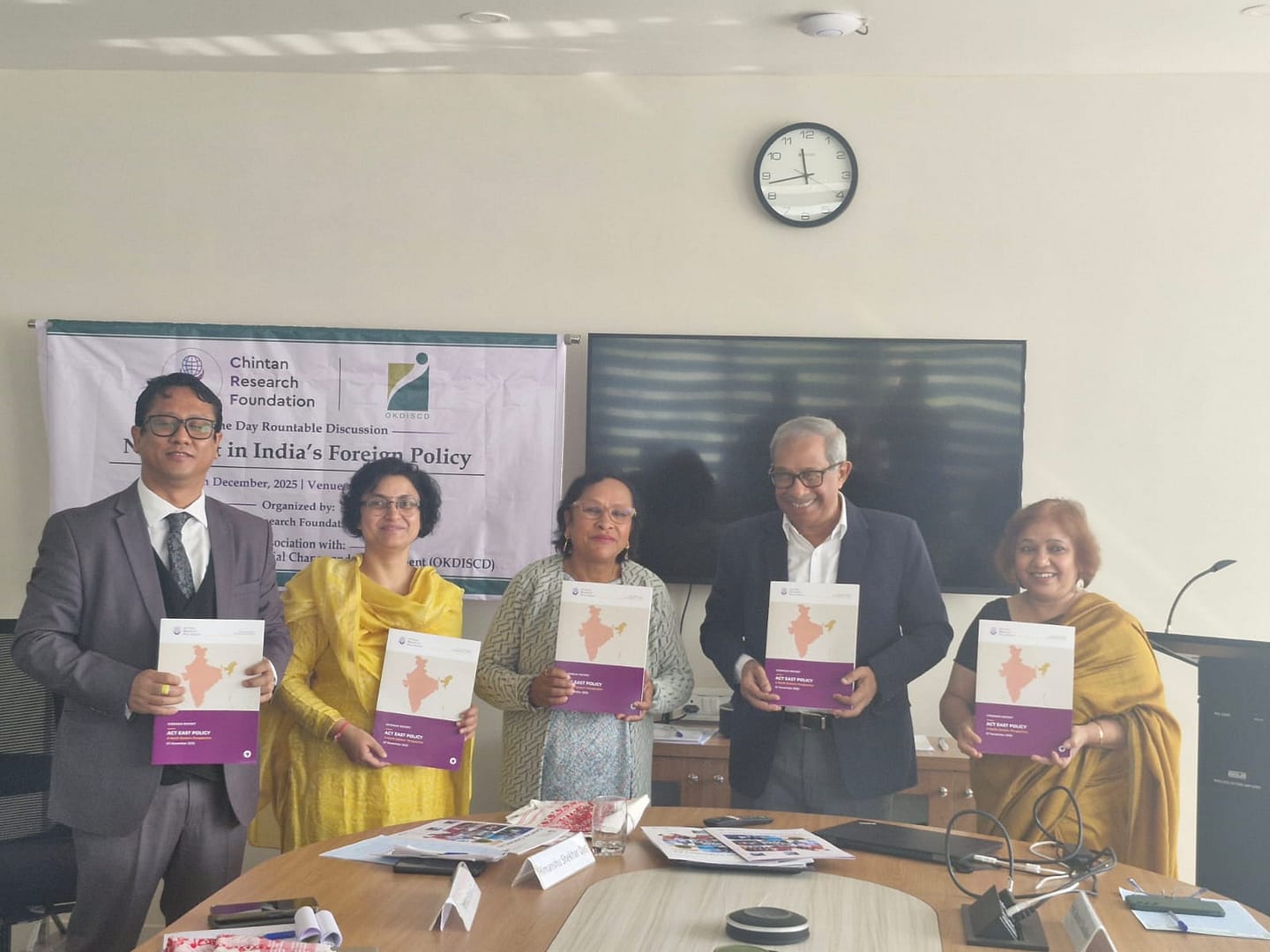
Former Additional Chief Secretary, Government of Assam, Dept. of Finance mentioned about India and China as re-emerging great powers and the position of Northeast in geopolitics of the region
OKDISCD in collaboration with Chintan Research Foundation (CRF), a think tank based in New Delhi organised a One Day Roundtable on ‘Northeast in India’s Foreign Policy’ in Guwahati on 19th December, 2025. In her welcome address, Prof. Saswati Choudhury, Acting Director, OKDISCD welcomed the participants and expressed her expectations from the round-table discussions that would help in policy-making on northeast and foster further collaboration between both the institutions. The inaugural address was delivered by Shri Himanshu Shekhar Das, Former Additional Chief Secretary, Government of Assam, Dept. of Finance where he pointed out that Northeast India has a long drawn problem emerging from artificial boundaries drawn by the colonial administration which still determines its course in contemporary times. He mentioned about India and China as re-emerging great powers and the position of Northeast in geopolitics of the region. He mentioned how environment, ecology, ethnicity, trade and such other issues need critical engagement and policy intervention. The session was chaired by Padmashree awardee Ms. Patricia Mukhim, Editor of The Shillong Times where she stressed the fact that apart from discussion on Act East Policy, ground realities including consideration of ecological sustainability, biodiversity and views of local stakeholders need to be strongly taken into consideration.
There were two panels—one on ‘Act East and Northeast India’ where faculty members from various universities across the region discussed and deliberated on the benefits, bottlenecks and the way forward of Act East Policy in their respective states. Though government is spending a lot of money in the name of development, however one strong point that came out from this panel was the disconnect between policy and local people which was not helping in the developmental agenda.
The second panel was on the ‘Northeast in India’s Foreign Policy’ where academicians from the region like Prof. M.P Bezbaurah talked about the Siliguri corridor, senior journalist Mrinal Talukdar spoke about the hydro politics of the region and China’s growing footprint in India’s neighborhood that might not be conducive for the development of the region in the future. Think tankers like Sabysachi Dutta talked about the necessity of having water diplomacy. Natural resources like forest, water etc. cannot be confined to the politics of nations was reiterated by the panelists.
Generic discussions on Act East Policy is no longer giving the people any new insights which calls for new frameworks to understand each of the eight states’ specific priorities. For instance, ‘Look South’ is a framework that Meghalaya is keen to pursue its relationship with Bangladesh. The macro geo-political and geo-economic development in the Indo-Pacific region needs to be better understood in order to assess their implications on the micro developments of India’s Northeast region.
In conclusion, the main point that emerged from the daylong deliberations was the need for stronger connect between academics, policy makers, media and local stakeholders.