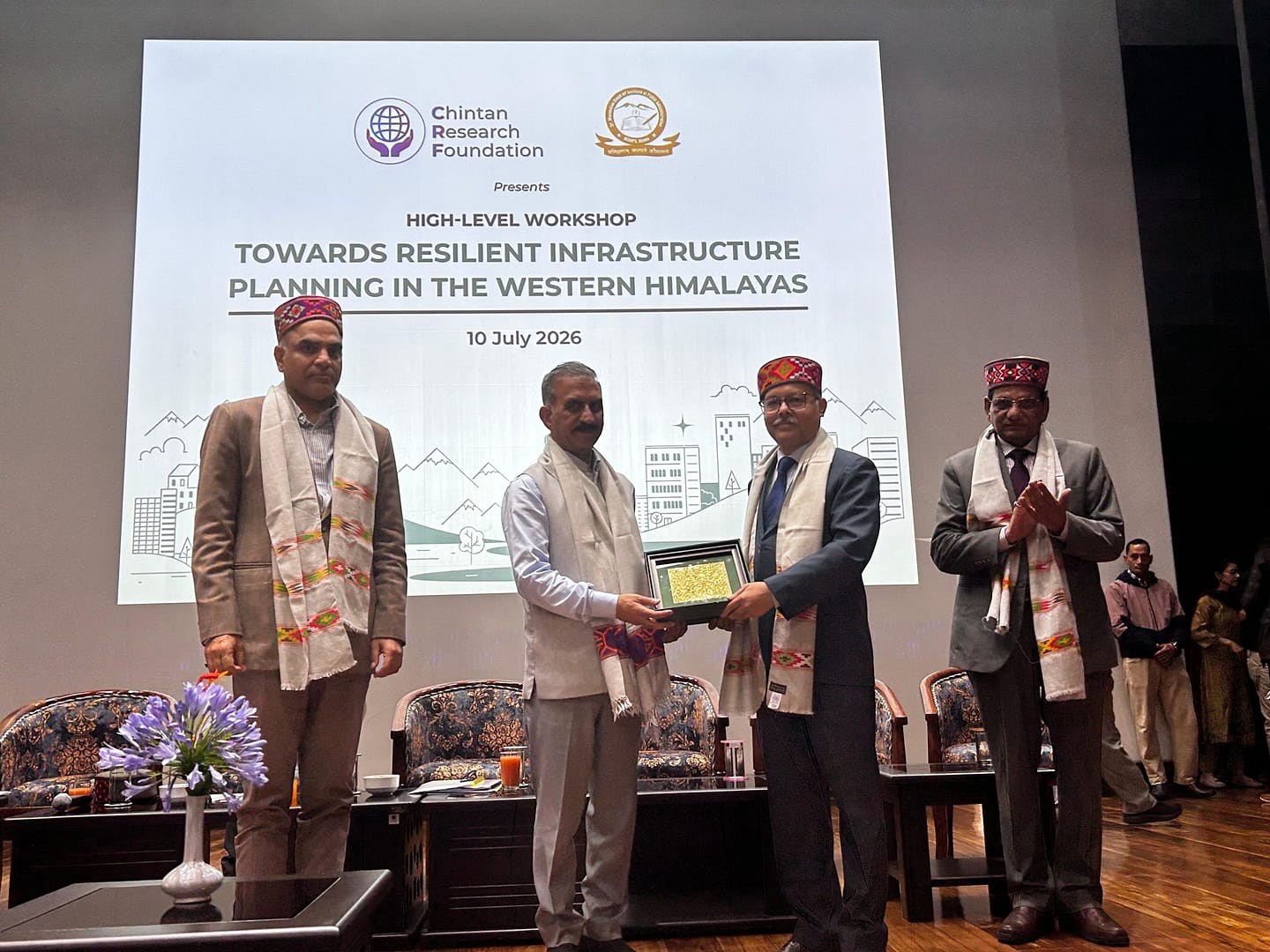
SHIMLA, July 10, 2026 /debcubspark.com-DigiTIMES./ — Calling for a fundamental shift in infrastructure planning across the fragile Himalayan region, Himachal Pradesh Chief Minister Sukhvinder Singh Sukhu on Friday urged government departments to adopt a coordinated approach to climate-resilient development, saying the lessons from recent disasters must shape future public investment and infrastructure design.
Addressing the valedictory session of a high-level workshop titled “Towards Resilient Infrastructure Planning in the Western Himalayas”, organised by the Chintan Research Foundation (CRF) in collaboration with the Dr Manmohan Singh Himachal Pradesh Institute of Public Administration (MSHIPA), the Chief Minister recalled the devastating disasters that struck Mandi district in 2025 and stressed the need for synchronised planning among line departments.
He said the Himachal Pradesh government remains committed to inclusive development and described climate-proof infrastructure as a critical pillar for ensuring sustainable growth in the hill state.
The workshop brought together policymakers, scientists, urban planners, engineers, disaster management experts and academicians to deliberate on integrating geological fragility and climate risks into infrastructure planning across the Western Himalayan region.
Opening the deliberations, Dr. Debajit Palit, Centre Head of the Centre for Climate Change and Energy Transition at CRF, said climate change in the Himalayas has evolved beyond an environmental issue into a development challenge with significant implications for public investment and long-term economic resilience.
Former Himachal Pradesh Chief Secretary and Chairman of the Himachal Pradesh State Electricity Board, Prabodh Saxena, said the interaction between climate change and the region’s inherent geological vulnerability has amplified socio-economic and infrastructure losses. Stressing the urgency of preparedness, he remarked, “If we do not prepare today, we are doomed to perish tomorrow.”
Delivering the keynote address, former NITI Aayog Member Dr. V. K. Paul said Himachal Pradesh has achieved notable progress in education, healthcare and other socio-economic indicators despite its difficult terrain. However, he cautioned that climate-induced disasters could significantly undermine these developmental gains unless infrastructure is systematically climate-proofed.
Representing the Ministry of Environment, Forest and Climate Change, Er. R. K. Singh emphasised the need for scientific infrastructure planning to reduce disaster risks in mountain regions.
During the event, dignitaries unveiled a discussion paper titled “Rethinking Infrastructure Development in the Western Himalayas Towards Climate-Resilient Infrastructure,” authored by CRF researcher Dr. Pooja Sehbag. The paper advocates integrating geological assessments, climate projections and hazard mapping into infrastructure planning from the earliest stages of project conception.
The workshop featured three technical sessions focusing on climate risks, geological fragility, resilient urban planning, governance reforms and institutional coordination. Experts underscored the importance of periodic risk assessments, context-specific planning and stronger collaboration among government departments.
The discussions also highlighted that conventional infrastructure models designed for stable terrain cannot be directly applied to the Himalayas. Instead, participants called for planning frameworks that incorporate local ecological realities, hazard mapping, engineering innovations and climate projections throughout the lifecycle of infrastructure projects.
The final session focused on policy and governance reforms needed to mainstream climate resilience into development planning. Experts unanimously advocated greater participation of local communities and stronger inter-departmental coordination to enhance the long-term resilience of Himalayan infrastructure.
Among those who addressed the workshop were Deepak Rawat, Vice President of the Himachal Pradesh State Disaster Management Authority; Chief Secretary K. K. Pant; Dr Pushpendra Rana, Director, Department of Environment, Science and Technology; Prof. Tikender Singh Panwar of Shoolini University; Dr Suresh C. Attri, Chief Scientific Officer, Department of Environment, Science, Technology and Climate Change; Dr Kirupasankar M., Conservator of Forests; Prof. P. K. Joshi of Jawaharlal Nehru University; Prof. Anjal Prakash of FLAME University; Prof. Mohd Sultan Bhat of the University of Kashmir; Pradeep Thakur, Town and Country Planner, Mandi; Er Sanjay Soni, Chief Engineer, Public Works Department; and Dr Nicolas Ziv, Lead Specialist, Coalition for Disaster Resilient Infrastructure.
The workshop concluded with a broad consensus that safeguarding future public investment in the Western Himalayas will require climate-informed planning, stronger institutional coordination and the integration of scientific risk assessments into every stage of infrastructure development.