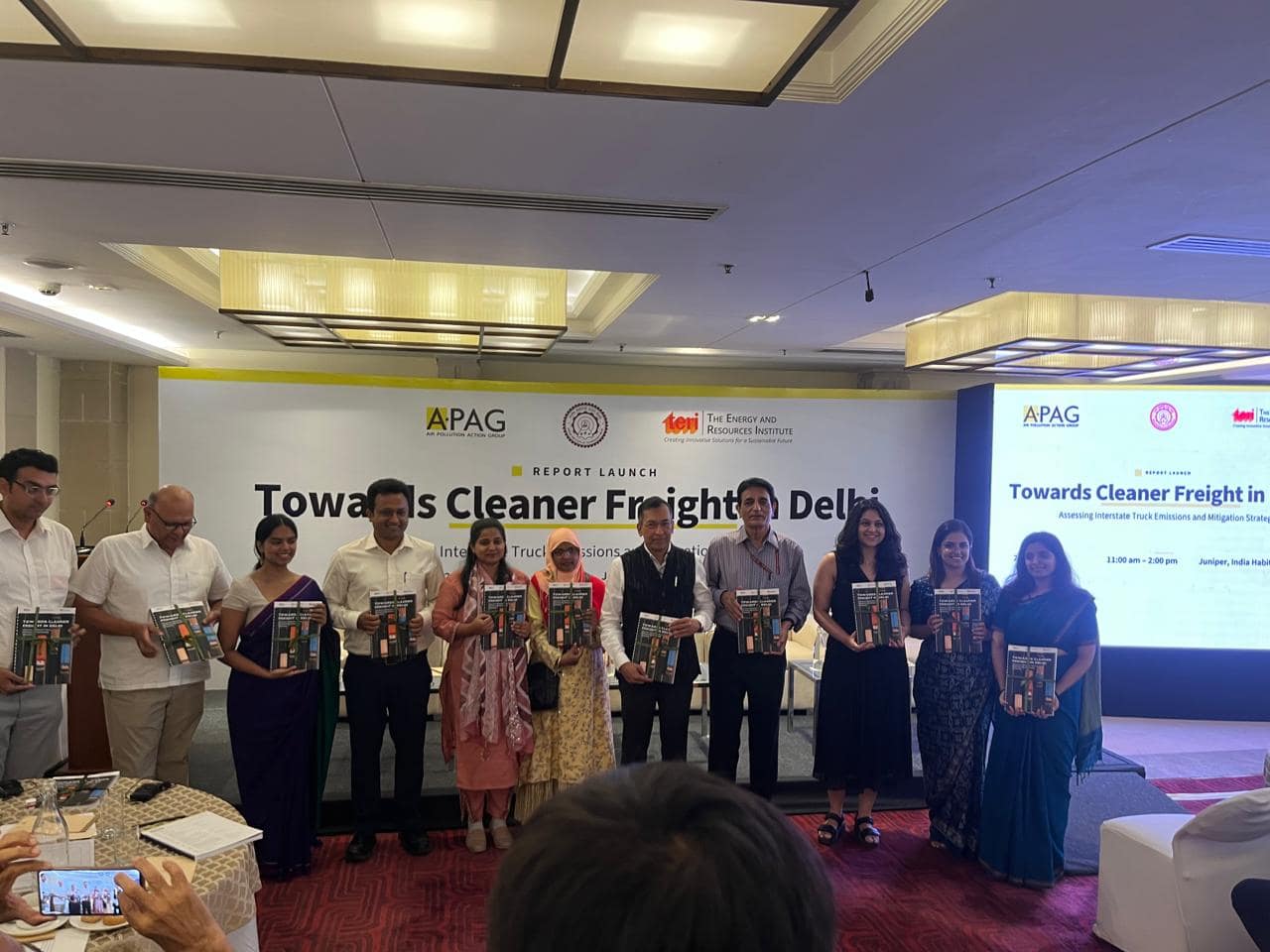
Nearly 16,900 interstate heavy-duty trucks enter Delhi every day, contributing significantly to the Capital’s deteriorating air quality, with freight transport accounting for almost one-fifth of transport-related PM2.5 emissions, according to a landmark study jointly released by the Air Pollution Action Group (A-PAG), The Energy and Resources Institute (TERI), and the Indian Institute of Technology Delhi (IIT Delhi) at TERI Headquarters on June 29, 2026 in New Delhi.
The report, “Towards Cleaner Freight in Delhi: Assessing Interstate Truck Emissions and Mitigation Strategies,” is among the most comprehensive assessments of interstate freight emissions undertaken in India. Combining RFID toll data, truck driver surveys, traffic counts, real-world tailpipe emission measurements and GPS-based route mapping, the study provides the first evidence-based roadmap for tackling pollution from interstate trucks entering the National Capital.
According to the report, Delhi receives an average of 16,900 heavy-duty vehicles (HDVs) every day, amounting to nearly half a million truck entries each month. While freight vehicles represent only a fraction of total vehicular traffic, they contribute disproportionately to harmful emissions because of their diesel-heavy fleet composition, larger engines and extensive night-time operations.
Speaking at the Report Launch event, Shri Mahmood Ahmed, Additional Secretary, Ministry of Road Transport & Highways (MoRTH), said, “This report fills the gap between the real-ground situation and policy-making, enabling the policy-makers to identify key areas of immediate and long-term importance and take necessary steps in a much more focussed and calibrated manner.”
Highlighting the significance of the report, Dr. Virinder Sharma, Member (Technical), Commission for Air Quality Management, National Capital Region (NCR) and Adjoining Areas, said, “By combining large-scale toll data analysis, on-ground traffic assessments, driver surveys and real-world emissions measurement using Portable Emissions Monitoring Systems (PEMS), it provides the most comprehensive evidence-based assessments to date of interstate HDV movement and its emissions profile in Delhi.”
According to Dr. Sharma, “Of the seven strategies to reduce freight emissions, works have already begun in the four. The present study makes a significant and timely contribution in picking up the gaps.”
One of the study’s most striking findings relates to night-time pollution. Nearly 75% of interstate trucks operate between 10 p.m. and 7 a.m., when atmospheric conditions prevent pollutants from dispersing efficiently. Although heavy-duty vehicles account for only about 23% of transport PM2.5 emissions over an entire day, their contribution rises to nearly 61% during restricted night-time hours, significantly worsening overnight pollution episodes.
The researchers estimate that interstate trucks emit approximately 52 tonnes of PM2.5, 143 tonnes of nitrogen oxides (NOx), and 25 tonnes of carbon monoxide (CO) every day within Delhi. Overall, freight movement contributes nearly 20% of transport-sector PM2.5 emissions, making it one of the city’s largest pollution sources after passenger transport.
The report also reveals that diesel vehicles continue to dominate Delhi’s freight sector. Around 80% of unique trucks entering Delhi run on diesel, while only about 20% operate on CNG. Heavy-duty diesel trucks, particularly older vehicles, remain the largest contributors to particulate matter and NOx emissions.
Contrary to the common perception that Delhi mainly serves as a transit corridor, the study finds that 92% of interstate trucks entering the Capital are actually destined for Delhi, while only 8% bypass the city. This suggests that most truck traffic is directly linked to Delhi’s economic activity and urban demand rather than through traffic.
The analysis further shows that 77% of interstate trucks originate from neighbouring NCR states, particularly Uttar Pradesh, Haryana and Rajasthan, highlighting the need for coordinated regional policy rather than Delhi-only interventions. Four major freight corridors—Kundli, Rajokri, Badarpur and Tikri—together account for more than half of heavy truck entries, making them critical locations for targeted enforcement and emission-control measures.
Based on its findings, the report recommends a seven-pronged strategy to reduce freight emissions. These include accelerating the transition to electric trucks, restricting entry of pre-BS-VI vehicles through Low Emission Zones (LEZs), phasing out older trucks using improved fitness testing and onboard diagnostics, deploying automatic number plate recognition (ANPR) cameras and weigh-in-motion sensors for stricter enforcement, reducing empty truck trips through better logistics planning, retrofitting older vehicles with particulate filters and NOx control systems, and promoting urban consolidation centres to improve freight efficiency.
Among the proposed measures, electrification offers the largest long-term environmental gains. The study projects that a complete transition of targeted freight segments to battery electric trucks by 2035 could virtually eliminate tailpipe emissions from those vehicles, reducing PM2.5, NOx and CO emissions by 100% compared with the business-as-usual scenario. In the near term, the researchers recommend focusing on high-utilisation two-axle trucks operating on shorter freight corridors before expanding electrification to larger commercial vehicles.
The report also identifies substantial gains from restricting older trucks. A complete ban on the entry of pre-BS-VI trucks through Low Emission Zones could reduce PM2.5 emissions by 51%, NOx by 83% and carbon monoxide by 94%, provided the restrictions are implemented across the Delhi-NCR region to prevent diversion of polluting vehicles to neighbouring districts.
The authors note that while Delhi has introduced several initiatives to improve vehicle emission standards and strengthen regulatory enforcement, freight transport has remained an under-addressed source of pollution. They argue that freight emissions require dedicated policies backed by regional coordination, real-world emissions monitoring, cleaner vehicle technologies and smarter logistics systems.
The study concludes that improving freight efficiency and accelerating the adoption of cleaner trucks could deliver substantial air-quality benefits while supporting sustainable economic growth. It recommends that Delhi and neighbouring NCR states adopt an integrated freight management strategy combining technological innovation, regulatory enforcement and infrastructure investments to achieve measurable reductions in air pollution over the coming decade.