India has entered a decisive political transition phase. The ongoing Rajya Sabha election cycle, leadership changes across key states, and the emergence of new regional power centres are collectively reshaping the country’s political architecture ahead of the next national electoral cycle.
While Lok Sabha elections often dominate public discourse, the real groundwork for political power is increasingly being laid in state assemblies and the Rajya Sabha. The Upper House has become a strategic arena where legislative control, coalition management, and long-term political influence are negotiated.
The developments unfolding in 2026 suggest that India’s political map is undergoing one of its most significant recalibrations in recent years.
The Rajya Sabha: More Than an Upper House Election
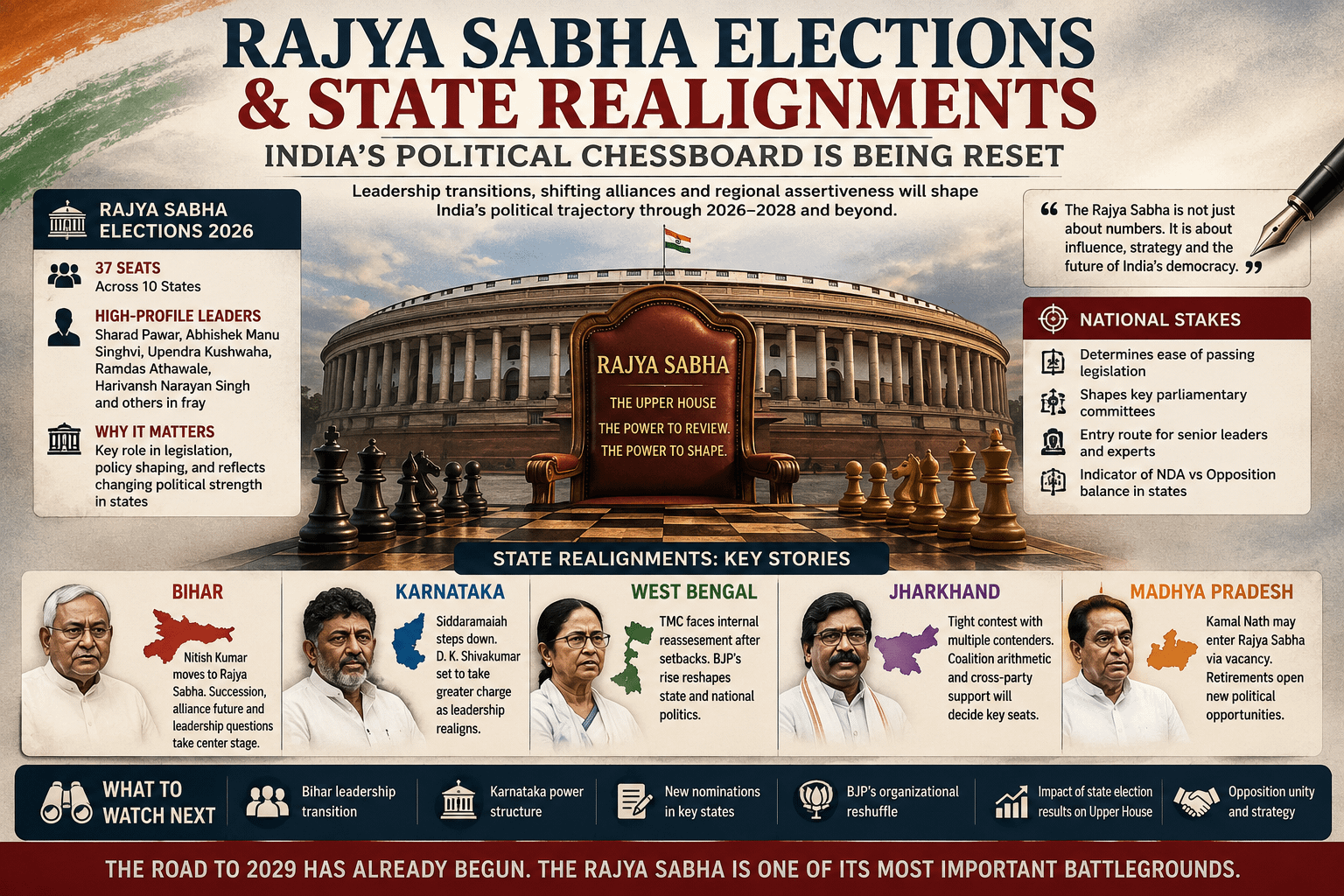
The 2026 Rajya Sabha elections involve 74 seats, including regular retirements and by-elections, making it one of the most politically consequential Upper House cycles in recent years. The National Democratic Alliance (NDA) currently maintains a numerical advantage, while opposition parties are attempting to preserve their influence through state-level alliances and strategic nominations.
Several senior political figures, including Sharad Pawar, Abhishek Manu Singhvi, Upendra Kushwaha, Ramdas Athawale, Harivansh Narayan Singh, and others have figured prominently in this election cycle, underlining the importance parties attach to the Rajya Sabha as a platform for national leadership and policy influence.
These elections are not simply about parliamentary arithmetic. They are indicators of which political forces are consolidating influence in state legislatures and which alliances are beginning to weaken.
Bihar Signals the End of an Era
The biggest political story remains Bihar. Nitish Kumar’s move to the Rajya Sabha has triggered intense debate over succession and the future structure of Bihar politics. For nearly two decades, Kumar has remained the defining figure of the state’s governance model and coalition politics. His transition toward national politics has inevitably raised questions about who will inherit political authority in Bihar and how power will be shared within the NDA framework.
The implications extend beyond Bihar. The state has historically shaped national coalition politics, and any restructuring of leadership there could influence opposition strategies and BJP expansion plans across northern India.
Karnataka’s Leadership Transition Reflects a Larger Trend
The resignation of Siddaramaiah and the expected rise of D.K. Shivakumar represent more than a routine leadership change. It reflects a broader challenge facing major political parties: managing generational transitions while maintaining internal cohesion.
Congress leaders have publicly framed the cabinet reshuffle and leadership transition as a renewal exercise aimed at countering anti-incumbency and preparing for future electoral contests.
For the Congress party, Karnataka remains one of its most significant governance laboratories. Stability and performance in the state will directly influence its national credibility as an alternative to the BJP.
Regional Politics Is Rewriting National Narratives
Perhaps the most striking development of 2026 has been the growing assertiveness of regional political forces.
In Tamil Nadu, actor-turned-politician C. Joseph Vijay and the Tamilaga Vettri Kazhagam (TVK) have disrupted decades of Dravidian dominance, emerging as a transformative force in state politics. The state’s political realignment has already triggered changes in alliance structures, including shifts involving Congress and regional players.
West Bengal has witnessed another major transformation. Recent election results indicate a dramatic reshaping of political power, with the BJP expanding its footprint in a state long dominated by regional forces. The outcome has national implications because Bengal remains one of India’s most politically influential states.
These developments reinforce an important reality: India’s political future will not be determined solely in New Delhi. It will be shaped by evolving regional aspirations, state leadership transitions, and changing voter coalitions.
The Opposition Faces a Defining Test
The opposition’s challenge is no longer merely electoral; it is organizational and ideological.
The INDIA bloc continues to face pressures arising from electoral setbacks, competing regional interests, and concerns about maintaining unity. Reports of growing unease among opposition parties reflect broader questions about leadership, coordination, and long-term strategy.
Without a coherent framework that accommodates both national ambitions and regional realities, opposition unity may remain difficult to sustain.
The Bigger Battle: Census, Delimitation and Representation
The Rajya Sabha elections are unfolding alongside even larger structural debates.
The digital Census exercise, caste enumeration, women’s reservation implementation, and delimitation discussions are expected to redefine political representation over the next decade. Legislative efforts related to delimitation and parliamentary restructuring have already intensified political debate regarding future seat allocation and federal balance.
These issues will directly affect how political parties calculate electoral strategies, allocate resources, and build social coalitions.
In many ways, the current Rajya Sabha contests are only the opening moves in a much larger political restructuring process.
The Road to 2029 Has Already Begun
The common perception that national politics begins with Lok Sabha campaigns is increasingly outdated.
India is already witnessing the early formation of the alliances, leadership equations, and regional power structures that will shape the next decade. The Rajya Sabha elections, Bihar’s transition, Karnataka’s leadership shift, Tamil Nadu’s political upheaval, and West Bengal’s changing landscape are all interconnected chapters of the same story.
The realignment underway is not merely electoral. It is institutional, demographic, and ideological.
India’s political chessboard is being reset. The parties that recognize these shifts early—and adapt accordingly—will be best positioned to influence the country’s future.