


| By Dr. Rajen Mehrotra
The First National Commission on Labour
India’s labour reform journey formally began in 1966 with the constitution of the First National Commission on Labour (FNCL), chaired by former Chief Justice of India P.B. Gajendragadkar.
The Commission was tasked with reviewing the working and living conditions of labour across organized and unorganized sectors. Its report, submitted in August 1969, was comprehensive and forward-looking. Yet, much of it remained unimplemented, with only select recommendations such as those relating to Works Committees and Contract Labour finding their way into legislation.
Mr. S.R. Mohandas (a well-known authority in the field of industrial relations) who was a visiting faculty, taught us the subject of Labour Laws & Industrial Relations. He asked the students to read the report, as the chairman of the report Justice P.B. Gajendragadkar was then the Vice-Chancellor of the University of Bombay. I, as a student remember reading this report, which has remained in cold storage to date and was never implemented.
The Second National Commission on Labour
Three decades later, the Second National Commission on Labour (SNCL) was constituted in October 1999 under the chairmanship of Mr. Ravindra Varma, former Union Minister for Labour. The SNCL was assigned only two tasks (i) suggest rationalization of existing laws relating to labour in the organized sector, and (ii) suggest an umbrella legislation for ensuring a minimum level of protection to the workers in the unorganized sector. In the terms of reference, the SNCL had a provision that they could submit an interim report which was not there in the terms of reference of FNCL. However, the SNCL chose not to submit any interim report. The SNCL submitted its report on 29 June 2002.
The SNCL recommended consolidation of India’s fragmented labour laws into broader thematic groups. Although the report was submitted in 2002, substantive reform materialised only with the enactment of the four Labour Codes between 2019 and 2020.
The Four Labour Codes
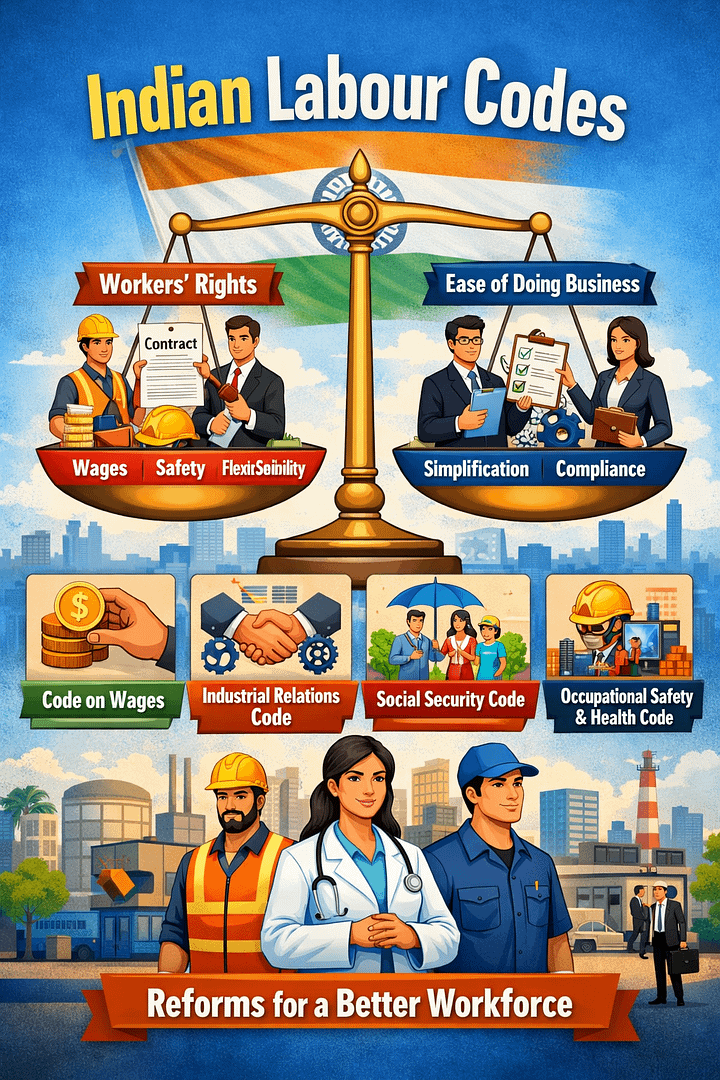
The Government consolidated 29 central labour laws into four Codes:
- Code on Wages, 2019
- Social Security Code, 2020
- Industrial Relations Code, 2020
- Occupational Safety, Health and Working Conditions Code, 2020
Together, they aim to simplify compliance, standardise definitions, expand coverage and modernise India’s labour regulation framework. These Codes became operational on 21 November 2025, marking a 23-year-gap between recommendation and implementation.
There is no separate labour code for the informal sector. Under the Wage Code, 2019, the Minimum Wage is guaranteed to all workers, including unorganized sector workers, with a statutory national floor wage. Also, the Gig & Platform workers are covered for social benefits under the Social Security Code, 2020.
The Central and State Governments (except Government of West Bengal) had prior to 21 November 2025 released Draft Rules and received objections and suggestions from citizens, organizations and stakeholders.
The Central Government has once again released the Draft Rules on 30 December 2025. A period of 30 days has been provided for submitting objections or suggestions on the draft rules for Industrial Relations Code, 2020, and a period of 45 days for the draft rules under the other three Labour Codes. It is likely that the Draft Rules will be finalized and released before 31 March 2026.
Key Structural Reforms
Uniform Definitions
A major reform is the standardisation of definitions such as “wages” and “worker” across all Codes, eliminating historical inconsistencies that triggered litigation.
Digital Compliance
Returns and registers are to be filed electronically through labour department portals, increasing transparency and accountability.
Fixed-Term Employment
Employers may engage workers on fixed-term contracts. If employment exceeds 12 months, gratuity becomes payable without the five-year qualifying requirement.
Threshold Revisions
Permission for layoff, retrenchment and closure is now required only for establishments employing 300 or more workers (earlier 100 or more workers). Contract labour registration thresholds have been raised from 20 to 50 workers. Factory definition thresholds have also been increased.
Universal Minimum Wages
Minimum wages now extend to all sectors and all employees, including informal workers, supported by a national floor wage framework.
The Draft Rules have identified occupations under each category: i.e., 116 in unskilled category, 134 in semi-skilled category, 323 in skilled category and 113 in highly skilled category.
Wage Definition Impact
Wages (basic + DA + retaining allowance) will be calculated at actual or at 50% of specified items of remuneration, whichever is higher for social security benefits and leave encashment. This significantly impacts funding for leave encashment and gratuity liabilities.
Leave Eligibility
The eligibility for earned leave now requires 180 days of work instead of 240 days — a clear worker benefit.
Canteen, Welfare and Safety
Canteens are mandatory at 100 workers strength (earlier 250). Welfare and Safety Officer thresholds have been reduced across industries, strengthening workplace standards.
Inclusion and Diversity
For the first time, transgender employees are explicitly recognised in welfare provisions; a progressive step toward inclusive workplaces.
Separate shelters or rest-rooms for male, female and transgender employees to be provided in every factory, mine plus motor transport undertaking wherein an employee is required to halt at night to be made available which employs fifty or more workers compared to the earlier limit of one hundred fifty or more.
In 2017, the Kochi Metro Rail Ltd (KMRL) in Kerala became India’s first government-owned entity to hire transgender employees, employing 23 individuals for housekeeping, customer care and crowd management to promote inclusivity. Since 2021, Tata Steel Ltd. has also actively employed over 100 transgender individuals, pioneering inclusivity in India’s industrial sector by integrating them into core operations like mining, crane operation and technical roles.
Trade Union Recognition
To date the law on recognition of trade unions was silent, except in certain states i.e. Kerala, Maharashtra & West Bengal. Recognition of trade union has been spelled out in the Industrial Relations Code, 2020 (i.e. after 99 years of The Trade Union Act, 1926 coming into force). The Industrial Relations Code formally introduces recognition of trade unions at the central level. As per the labour Code if only one registered trade union is functioning in an industrial establishment, the employer must, subject to prescribed criteria (i.e. minimum 20% membership as mentioned in the draft rules) recognise that union as the sole negotiating union for the workers.
If more than one registered trade union operates in an industrial establishment, the employer must recognise the trade union that has the support of 51% or more of the workers on the muster roll as the negotiating union. Also, if multiple registered trade unions exist and none has the support of 51% or more workers, the employer must constitute a Negotiating Council. The Negotiating Council will include representatives from registered trade unions that have the support of at least 20% of the total workers, with one representative for each 20% of membership (and proportionate representation for any remaining fraction).
Contract Labour Regulation
Contract labour is restricted to defined non-core activities i.e. sanitation, security, canteen services, housekeeping, transport, civil and constructional works including maintenance, gardening, courier services, with limited exceptions. Principal employers must provide equivalent health, safety and welfare facilities to contract workers.
Appointment letters are mandatory including for contract workers. Draft Rules specify the content of the appointment letters. Establishments need to check their existing employment letters and issue an addendum to the existing employment letters if items mentioned in the Rules are not there in the existing employment letters.
Inter-State Migrant Workers
Employers must ensure registration and annual travel allowance payments from his/her native place to the place of his/her employment for eligible migrant workers, currently defined as those earning below ₹18,000 per month. This limit may be raised as it was incorporated in the Labour Code in 2020.
Penalties and Enforcement
Penalties for non-compliance have increased substantially, with fines ranging from ₹50,000 to ₹5 lakh and imprisonment provisions extending up to three years. Power has been given to officers of appropriate Government to impose penalty in certain cases.
Key implementation challenges:
- In an establishment when there is an agitation by the workers involving violence, management of the establishment declare a Lockout to contain the situation. Declaration of lockouts will now technically become illegal, as the employer has to give fourteen days’ notice and the subject matter will get into conciliation. Employers will have to use innovative methods to avoid the Lockout being declared illegal.
- Every industrial establishment employing 20 or more workers will have to constitute a Grievance Redressal Committee to address individual employee grievances. The Committee must have an equal number of representatives from Employer & Workers and the total number of members must not exceed 10. Chairman post is rotatory annually. Majority vote means at least 50 % of the worker’s representatives must endorse the decision along with the Employer’s. This Committee is mandatory and the earlier practice where companies had a grievance redressal mechanism with all representatives of the employer is no more valid under the Labour Code.
- The Code on Wages restricts all deductions to 50% of wages. It is uniform and protective compared to earlier 75% for deductions.
- Settlement of Wages has to be done within two working days for resignation, dismissal and termination cases. Earlier this was applicable only in the cases of dismissal and termination. Whenever an employee resigns, he/she is governed by the contract of employment, which in most cases gives the option for immediate release, if the employee agrees to pay for the notice period. In case of employees, who are paying for the notice period and seeking immediate release, it will be tough for the establishment to settle the wages in two working days, as payroll for most establishments is outsourced and obtaining the computation within this time period will be tough.
- An independent director cannot be an ‘Occupier’. This is a change from the previous law. Hence only the Managing Director or an Employee Director on the Board can be an occupier.
- Under Duties of Employers it is stated that annual health examination of such employees of such age or such class of employees or establishments or such class of establishments, as may be prescribed by the appropriate Government. When the Labour Codes were made operational from 21 November 2025, there were advertisements by the Government of India in leading national and regional newspapers that all employees above the age of 40 years will be medically examined annually at the cost of the employer.
- The Occupational Safety Health & Working Conditions Code, which deals with The Building and Other Construction Workers (Regulation of Employment and Conditions of Service) Act, 1996 states that a person who is deaf or has a defective vision or tends to giddiness be not employed in building or other construction work which is likely to involve a risk of any accident either to the building worker himself or to any other person. Establishments engaging Building and Other Construction Workers will have to get these workers medically examined and ensure they do not have these medical limitations.
Implementation strategy for establishments
Leading organisations are:
Major trade unions organised nationwide protests against the implementation of the four new labour codes in February 2026, citing concerns about increased retrenchment thresholds, restrictions on strikes, and expansion of fixed-term and contract labour arrangements.
- Conducting compliance audits
- Reviewing workforce classification
- Restructuring salary components
- Updating employment contracts
- Revising policies to align with the Codes
Trade Unions Concerns
The trade unions claim that the Codes are anti-worker, pro-corporate and threaten to reduce workers to “virtual slaves” by increasing working hours to 12 per day and restricting strikes.
Some of the reasons why Trade Unions have reservations about the Labour Codes are as follows:–
- Strikes technically will now be illegal.
- Layoff, retrenchment & Closure permission from Government threshold limit revised from 100 to 300 and no change in compensation, though The Second National Commission on Labour had recommended higher compensation both for retrenchment and closure.
- Too much of Contract Labour in establishments. The Second National Commission on Labour had recommended that Contract labour not be engaged for core production/service activities but it also suggested that Contract labour to be remunerated at the rate of regular labour. However, these recommendations are not part of the Code.
- The Four Labour Codes represent the most significant labour reform in independent India. Whether they ultimately prove transformative or contentious will depend not merely on statutory language, but on how employers, workers and governments interpret and implement them.
For HR leaders, the Codes are not merely a compliance exercise. They demand strategic workforce planning, constructive industrial relations, transparent compensation structures, and strong governance. The responsibility now rests on organisations to move beyond compliance toward responsible, inclusive and sustainable employment practices. It is with passage of time that establishments and trade unions will realise and answer whether the Four Labour Codes are “a boon or bane”.
The author is Past President of Industrial Relations Institute of India (IRII), Former Senior Employers’ Specialist for South Asian Region with International Labour Organization (ILO) and Former Corporate Head of HR with ACC Ltd. and Former Corporate Head of Manufacturing and HR with Novartis India Ltd. Continues to maintain close links with the academic world as a visiting faculty with some of the IIMs. E-Mail: rajenmehrotra@gmail.com
** Based on the online session talk by the author on “Impact of Labour Codes on Establishments” organised by Indian Society for Training & Development (ISTD), Mumbai Chapter on Friday 06th February 2026.
Published in March 2026 issue of “Current Labour Reports (CLR).