India’s education sector is undergoing a major phase of examination reforms as concerns over paper leaks, technical failures, transparency, and institutional accountability trigger calls for systemic restructuring of the country’s testing ecosystem.
The debate has intensified following the NEET-UG 2026 paper leak controversy, which has now reached the Supreme Court and reignited questions about the functioning of the National Testing Agency (NTA), the body responsible for conducting many of India’s largest entrance examinations.
NEET Crisis Sparks National Reform Debate
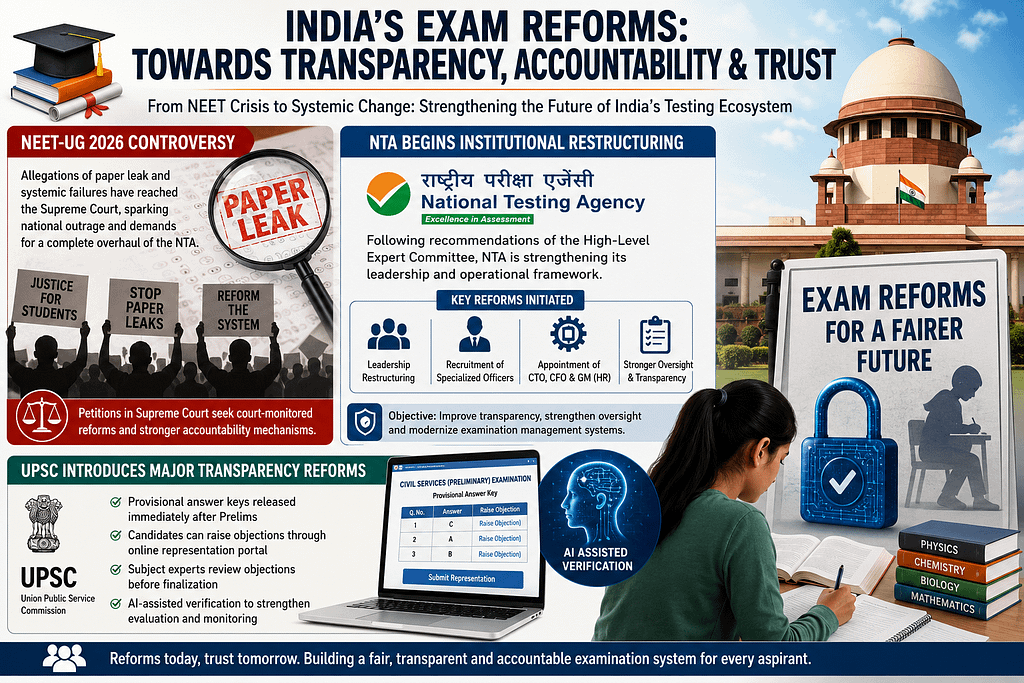
The NEET-UG 2026 controversy has become the biggest catalyst for examination reforms in recent years. Petitions before the Supreme Court have demanded a complete overhaul of the NTA, court-monitored reforms, and stronger accountability mechanisms after allegations of systemic failures in examination security.
Medical associations and student organizations have argued that recurring irregularities have weakened public trust in high-stakes entrance examinations that determine the futures of millions of students. The Centre, NTA, and investigating agencies have been asked to respond as scrutiny over examination governance intensifies.
NTA Begins Institutional Restructuring
In response to mounting criticism, the NTA has announced several institutional reforms aimed at strengthening examination integrity and operational capacity.
According to an official government release, the agency has begun restructuring its leadership framework, appointing senior officers and initiating recruitment for specialized positions including Chief Technology Officer (CTO), Chief Financial Officer (CFO), and General Manager (Human Resources). These measures are being implemented following recommendations made by a High-Level Expert Committee on examination reforms.
Government officials say the objective is to improve transparency, strengthen oversight mechanisms, and modernize examination management systems.
UPSC Introduces Major Transparency Reforms
In a significant move, the Union Public Service Commission (UPSC) has introduced one of the biggest procedural reforms in its history by releasing provisional answer keys immediately after the Civil Services Preliminary Examination.
Candidates are now allowed to raise objections through an online representation portal, enabling subject experts to review disputed answers before finalization. UPSC has also introduced AI-assisted verification systems to strengthen evaluation processes and improve examination monitoring.
UPSC Prelims 2026 Data
| Indicator | Latest Figures |
| Registered Candidates | 8.19 lakh+ |
| Attendance Rate | Around 67% |
| Examination Centres | 2,072 |
| Cities Covered | 83 |
| Highest Participation | Delhi (70,885 candidates) |
| Lowest Participation | Kargil (98 candidates) |
Education experts view the answer-key reform as a major step toward increasing transparency and reducing dependence on unofficial evaluation sources.
Technology-Driven Examination Systems Expand
Authorities are increasingly considering technology-led reforms, including:
- Computer-Based Testing (CBT)
- AI-powered monitoring systems
- Advanced biometric verification
- Real-time surveillance mechanisms
- Digital question-paper security systems
- Automated evaluation tools
The possibility of shifting future NEET examinations toward a larger CBT-based model is also under discussion, though no final decision has been announced.
Unified Entrance Exam Under Consideration
The government is reportedly evaluating proposals for a more integrated national entrance examination framework that could streamline admissions across professional courses and reduce duplication in testing systems.
Experts argue that such a framework could lower costs for students, reduce examination stress, and improve administrative efficiency while strengthening security protocols.
Examination Disruptions Highlight Systemic Challenges
Recent years have witnessed repeated disruptions across national and state-level examinations, including paper leaks, technical glitches, biometric verification failures, and exam cancellations.
The cancellation of NEET-UG 2026 after allegations of a paper leak has once again exposed structural weaknesses in India’s examination architecture. Analysts argue that conducting high-stakes examinations for millions of candidates on a single day creates significant vulnerabilities and operational risks.
A government-appointed expert committee has reportedly submitted 101 recommendations covering examination security, institutional restructuring, technological safeguards, data protection, and mental-health support for candidates. Many of these recommendations are currently under implementation or review.
School Education Reforms Also Accelerate
Alongside entrance-exam reforms, broader changes are taking place within school education.
A recent NITI Aayog report highlighted that India operates the world’s largest school education system, comprising:
- 14.71 lakh schools
- 24.69 crore students
- Coverage across all 36 States and Union Territories
The report recommends stronger learning-outcome tracking, greater digital integration, competency-based assessments, and improved educational quality monitoring.
CBSE is also moving toward competency-based evaluation models, reduced emphasis on rote learning, and expanded continuous assessment systems aligned with the National Education Policy (NEP) framework.
Editorial Perspective
India’s examination system stands at a critical turning point. With millions of students competing for limited educational and employment opportunities every year, public confidence in examinations is essential for social mobility and institutional credibility.
The current reform push goes beyond preventing paper leaks. It is fundamentally about rebuilding trust through transparency, technology, accountability, and fairness. The success of these reforms will not only shape the future of competitive examinations but also influence the broader credibility of India’s education and recruitment systems.
For a country with one of the world’s youngest populations, ensuring that examinations remain secure, merit-based, and transparent is not merely an administrative challenge—it is a national priority.