
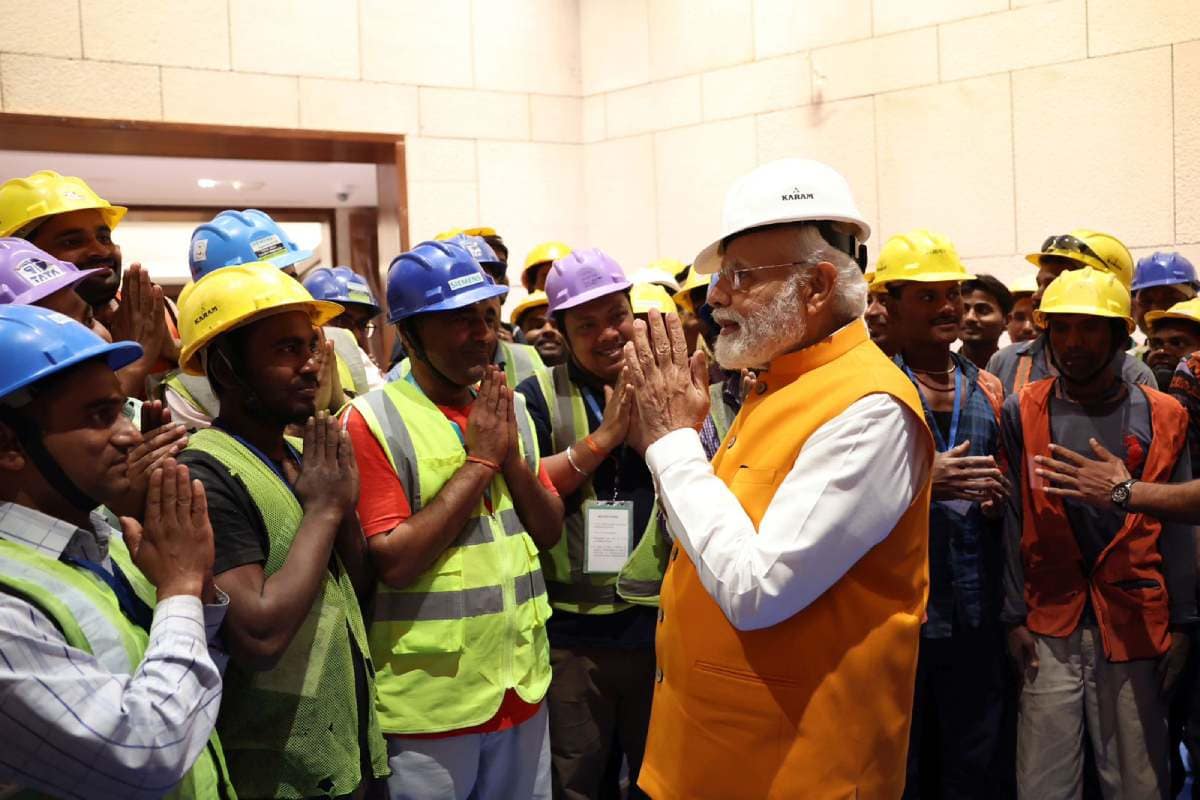
India is a vast sub-continent with a billion dreams. It’s aspirational! The country has grown out of severe instances of economic doldrums. With a population touching above 1.4 billion and counting, our dreams of a developed aka Viksit Bharat is gaing ground and traction across formal sectors. The PM Modi-led agenda for the New Bharat is on table and in right course. Cuting in the path for Viksit Bharat isn’t a trajectory of growth laid overnight. And that too in the backdrop of ever-increasing population with green shoots of apsirational India just set rolling, for the most part, in the formal sector of our economy. That our economy aspires to become a $5 trillion powerhouse in the face of the informal workforce dented by harsh realities needs a critical look based on the recent ILO report, which pointed out “exploitative conditions” and continued existence of “forced labour” blotting the landcape of $5 trillion economy.
The ILO reports that over 300 million workers accounting for approx. 93% of the total work force are employed in the unorganised sector.
Be it feudalism or modern slavery, it persisted in one form or the other the world over. To put it into context of modern India, slavery and feudalism have lost their existence. However, according to The Hindu, India’s vast swathes of people live in conditons of modern slavery among G20 nations with an estimated 11 million individuals affected. Another report from The Quint has it that India’s unregulated informal sector contributes to illegal profits amounting to over $230 billion annually. Such existence of forced labour over and above the formal economy add to the woes of black economy in terms of generating illegal income that largely remains unaccounted for and end up in the hands of the few. This economic mess is continually aggravated by systematic existence of poeverty, discriminiation, and limited labour protections which push individuals into “exploitative work arrangements”.
India’s path to economic bloom and boom has been doomed by the workers exploitation in the unorganised sector. The exploitative conditions of the workers exist in various forms. A significant number of workers are reeling under delayed or non-payment of wages in comparison to the amount of work they put in. There is another issue that throws the workers out of gear is lack of job contracts further aggravated by arbitrary dismissal without consent and legal action. Referring to the workers’ safety in the unorgainsed sector, it’s one of mess accelerated by hazardous environments invoving workers to go without safety gears putting their lives at risk. In terms of work-life balance, the unorgainsed sector workers bear the brunt of unpaid leaves and nearly non-existent social security benefits such as health insurance and retirement benefits pushing their econonic security to the wall. To name a few, these harsh conditions are true of sectors including construction, agriculture, and domestic work – which makes the matter worse in the form of bonded labour and debt bondage.
The PM Modi-led agenda for Viksit Bharat is on a course for taking measures that would for sure bring in a huge mass of revolution across sectors, including the unorganised sector. For a starter, the Indian government has taken a number of measures aimed at improving conditions for unorganised workers, such as the Unorganised Workers’ Social Security Act, 2008, and the Pradhan Mantri Shram Yogi Maan-Dhan Yojana. Additionally, the Occupational Safety, Health and Working Conditions Code, 2020, and the Social Security Code, 2020, were introduced to consolidate and amend laws relating to the welfare of workers in the informal sector.
The new labour reforms are targeted at creating a more efficient and worker-friendly labour market so as to promote social and financial inclusion and facilitate ease of doing business (EODB). These reforms are on track along the lines of Sustainable Development Goals (SDGs) to add to the development agenda of “Viksit Bharat”.
Admittedly, the effectiveness of these initiatives is hindered by weak enforcement, lack of awareness among workers, and bureaucratic challenges. For instance, the implementation of the Mahatma Gandhi National Rural Employment Guarantee Act (MGNREGA) has faced issues such as delayed wage payments and inadequate budget allocations, leading to unmet demand for work. Addressing these issues is crucial not only for the welfare of millions of workers but also for the sustainable economic growth of India.