



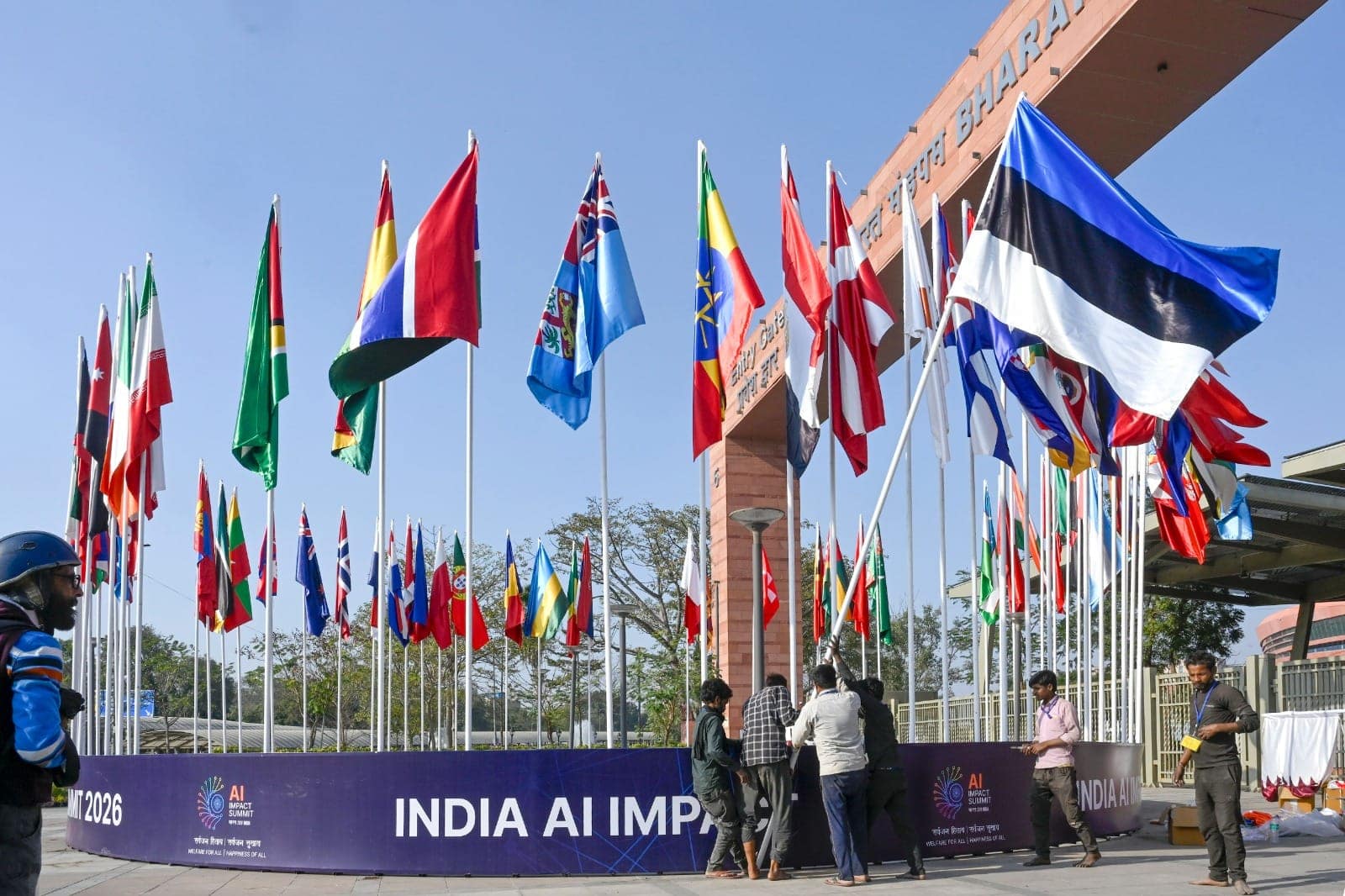
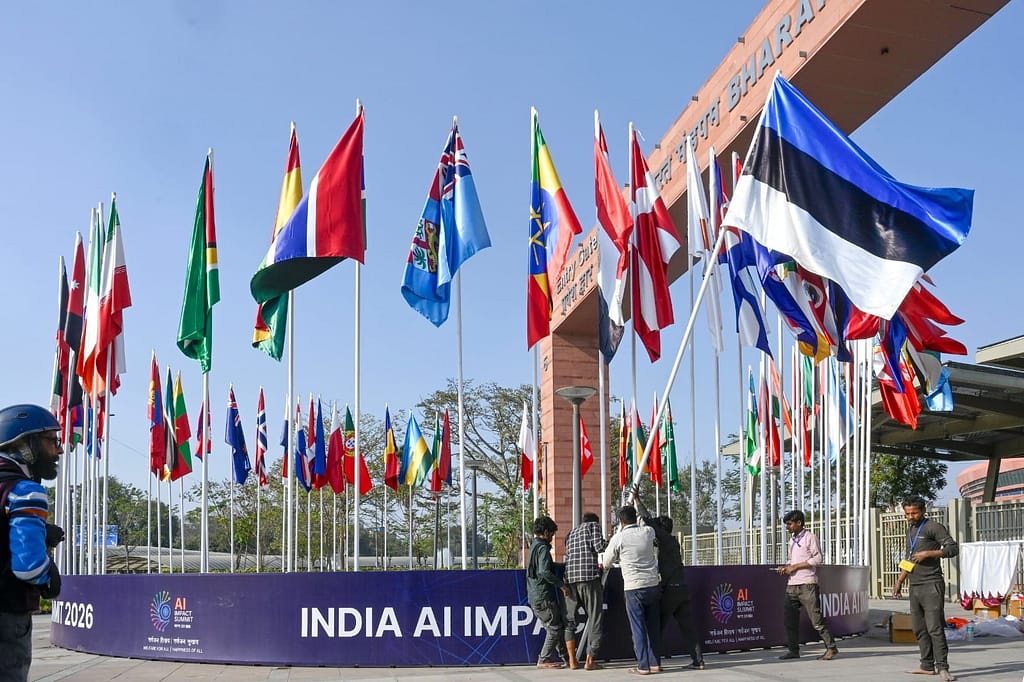
New Delhi has been transformed into a multi-layered security zone ahead of the five-day India-AI Impact Summit that begins on February 16. The global event, scheduled to continue until February 20, is being held at Bharat Mandapam, where authorities have deployed one of the most advanced and technology-driven security arrangements ever seen in the national capital.
Officials said the summit’s security setup reflects a strong integration of artificial intelligence, modern surveillance systems, and specialized defense units. The arrangements cover airspace, ground operations, digital monitoring, and movement control to ensure complete safety for visiting global leaders, delegates, and participants.
Three-Tier Security from Sky to Ground
To counter aerial threats, five anti-drone systems and four air defense guns have been deployed around the venue. These systems are capable of detecting and neutralizing suspicious unmanned aerial vehicles within seconds. Security agencies said such advanced measures are necessary due to increasing global concerns over drone-based threats.
On the ground, elite security forces have taken charge of different layers of protection. The National Security Guard commandos, commonly known as the Black Cats, have been stationed to respond to any emergency or terror-related situation. Meanwhile, the responsibility for the internal security of the Prime Minister and other high-profile global dignitaries rests with the Special Protection Group.
Outer security rings are being monitored by paramilitary forces, including the Central Industrial Security Force, Border Security Force, Central Reserve Police Force, and Indo-Tibetan Border Police. In addition, more than 10,000 personnel from the Delhi Police have been deployed across key locations, supported by hundreds of wireless communication sets and thousands of emergency lighting units.
AI-Powered Smart Surveillance
One of the key highlights of the security arrangements is the use of AI-based monitoring systems. Authorities have divided the summit area into 10 zones and 22 sectors, all connected through an integrated command, control, communication, and intelligence network.
AI-enabled cameras are capable of analyzing crowd behavior in real time, detecting unattended objects, and identifying suspicious activities instantly. A centralized control room has been established at an NDMC building, where security teams continuously monitor live footage and coordinate rapid responses if needed.
Digital Entry and GPS Tracking
Security protocols also include strict digital access systems. Entry to the summit venue is allowed only through digital passes verified by QR code scanning. Officials said this measure ensures accurate identification and prevents unauthorized access.
Vehicles involved in sanitation, logistics, and essential services have been equipped with GPS tracking devices to ensure they follow pre-approved routes and schedules.
Special Arrangements for VVIP Movement
Given the participation of several heads of state and international representatives, authorities have implemented special movement protocols. A dedicated hotline system has been created to ensure smooth coordination between traffic and security agencies during VVIP convoys.
The Government of India has also arranged a fleet of bulletproof vehicles for foreign dignitaries. Hotels hosting international delegates have been under enhanced security surveillance for nearly two weeks, with senior police officers directly supervising safety operations.
Officials said the elaborate arrangements not only demonstrate India’s preparedness to host high-profile global events but also showcase its rapidly advancing capabilities in technology-driven security management.