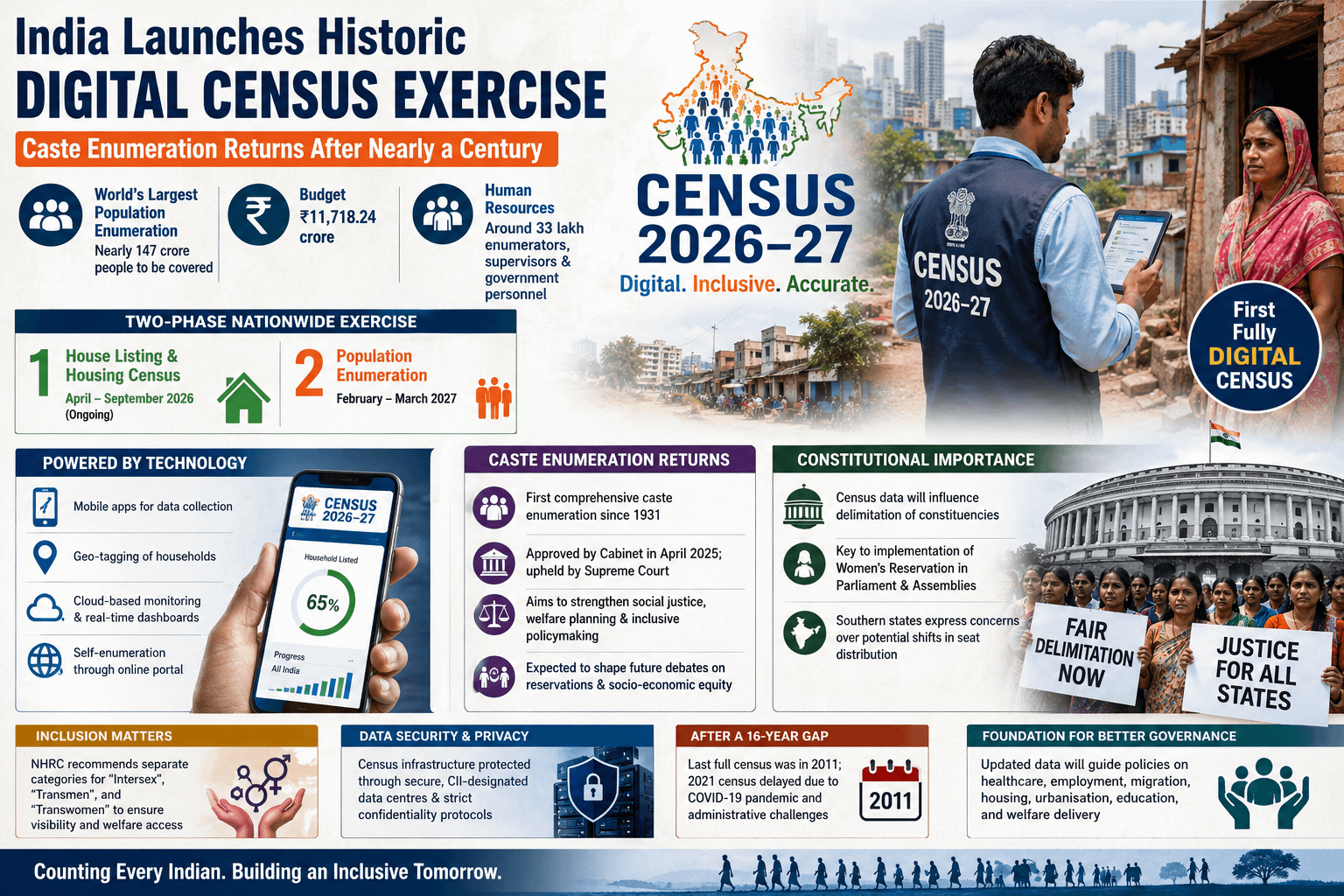
India has formally begun preparations for its biggest demographic exercise in history, with Census 2026–27 emerging as one of the country’s most politically and administratively significant national projects in decades.
The first phase of the nationwide census operation began on April 1, 2026, marking India’s first fully digital census and the first comprehensive caste enumeration exercise since 1931.
Officials say the two-phase exercise will continue until early 2027 and is expected to cover an estimated population of nearly 147 crore people, making it the world’s largest population enumeration programme.
According to the Office of the Registrar General and Census Commissioner, the House Listing and Housing Census phase is currently underway across states and Union Territories and will continue until September 2026. The second phase — Population Enumeration — is scheduled for February–March 2027.
The Union government has allocated ₹11,718.24 crore for the operation, which will deploy approximately 33 lakh enumerators, supervisors, and government personnel nationwide.
First Fully Digital Census
For the first time in India’s census history, enumerators are using mobile applications, geo-tagging systems, cloud-based monitoring platforms, and real-time digital dashboards instead of traditional paper schedules. Citizens also have the option of self-enumeration through the official online portal.
Government officials describe the exercise as a major shift toward technology-driven governance aimed at improving speed, transparency, and accuracy in data collection.
The digital rollout is already producing mixed regional results. Haryana’s Charkhi Dadri district recently emerged as the state’s top-performing district with a 65% completion rate in house-listing operations, while major urban centres such as Gurugram and Manesar reported slower progress due to migration and verification challenges.
In Uttar Pradesh alone, nearly five lakh officials are expected to participate in the two-phase operation beginning May 2026.
Caste Enumeration Returns
The most politically significant development is the inclusion of caste enumeration for the first time in nearly 100 years. The Cabinet Committee on Political Affairs approved the move in April 2025, describing it as a step toward “inclusive and targeted policymaking.”
The decision has intensified political debate across the country, with supporters arguing that updated caste data is essential for welfare planning, reservation policies, and social justice programmes.
Last week, the Supreme Court backed the government’s decision, observing that there was “nothing wrong” in collecting data on backward-class populations.
The census is expected to become a key reference point for future policy debates surrounding reservation quotas, welfare distribution, and socio-economic inequalities.
Delimitation and Women’s Reservation Link
The census has also acquired constitutional importance because its data is expected to influence the next delimitation exercise and implementation of women’s reservation in Parliament and state assemblies.
A constitutional amendment proposed earlier this year to enable delimitation using older 2011 Census data failed to secure the required parliamentary majority, effectively linking future seat redistribution to the completion of Census 2027.
This has revived concerns among southern states over potential shifts in parliamentary representation based on population growth trends.
Inclusion and Data Concerns
Meanwhile, rights groups and commissions have pushed for broader representation in the census framework.
The National Human Rights Commission recently recommended the inclusion of separate categories for “Intersex”, “Transmen”, and “Transwomen” to improve recognition and welfare planning for gender minorities.
Privacy and data security remain another major concern as India transitions to digital enumeration. The government has stated that census infrastructure is being protected through secure Critical Information Infrastructure-designated data centres and strict confidentiality protocols.
First Census in 16 Years
The exercise is taking place after an unprecedented delay. India’s last full census was conducted in 2011, while the 2021 census was repeatedly postponed due to the COVID-19 pandemic and administrative disruptions.
Officials say the updated demographic data will become critical for policymaking in areas including healthcare, employment, migration, housing, urbanisation, education, and welfare delivery.
As India attempts to digitally count nearly 1.5 billion citizens across thousands of towns, villages, and remote regions, Census 2026–27 is being viewed not merely as a statistical exercise but as one of the defining governance projects of modern India.