Financing India’s EV Transition: Experts Discuss Infrastructure, Capital and Policy Priorities
 Staff, DigiTIMES.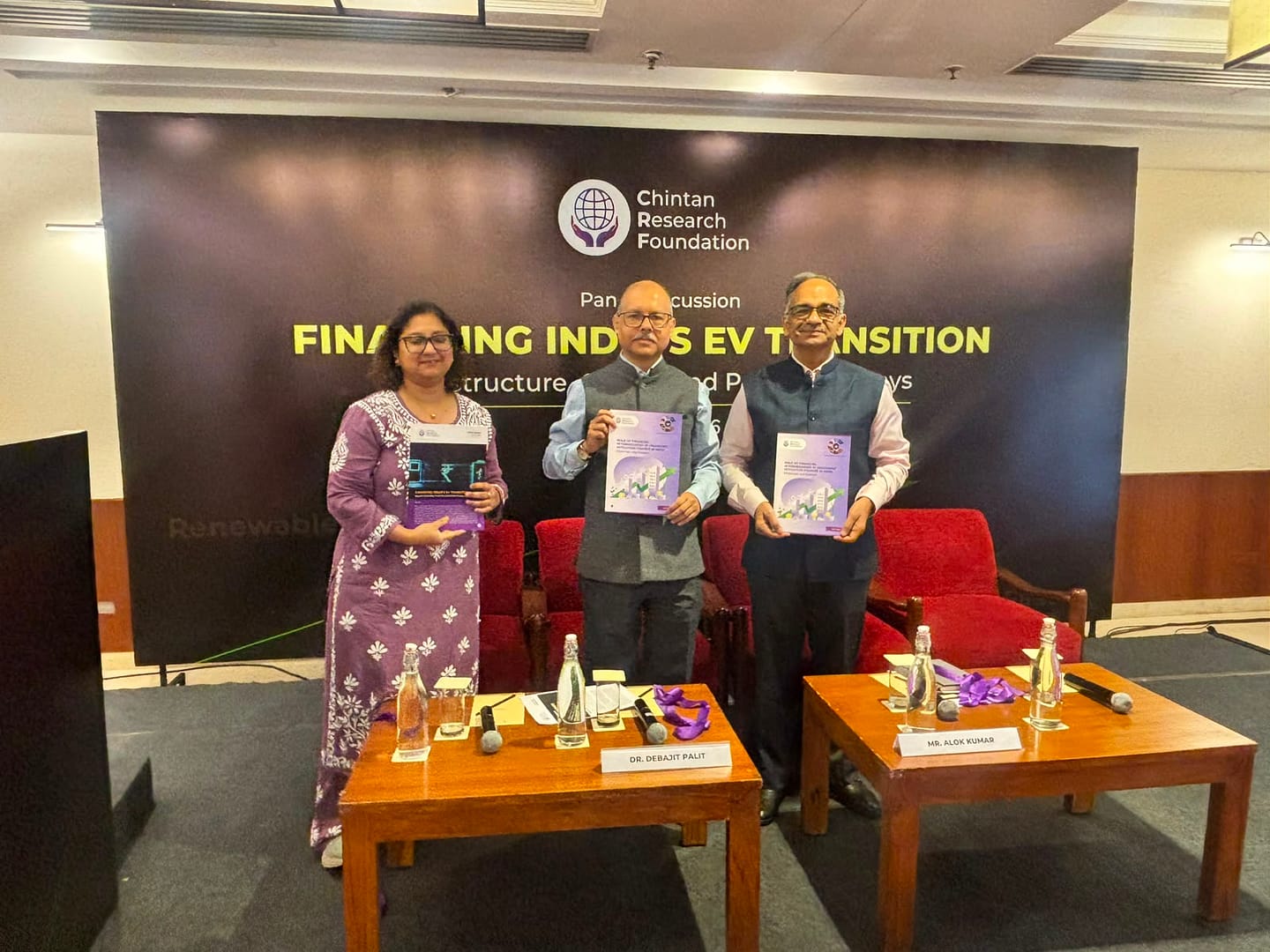
Transport electrification is not merely a transport policy, it is an energy security as well as an environmental strategy, said Dr. Debajit Palit, Centre Head, Centre for Climate Change and Energy Transition, CRF. (via CRA media outreach)
NEW DELHI, June 25, 2026 /debcubspark.com-DigiTIMES./ — “Electric mobility offers immense potential for addressing India’s energy needs, while also driving green growth and improving air quality,” said Mr. Alok Kumar, Director General, All India Discoms Association (AIDA) and former Secretary, Ministry of Power, Government of India, at the panel discussion on “Financing India’s EV Transition: Infrastructure, Capital and Policy Pathways,” organised by Chintan Research Foundation (CRF) on 25 June 2026 at the India Habitat Centre, New Delhi.
In his welcome remarks, Dr. Debajit Palit, Centre Head, Centre for Climate Change and Energy Transition, CRF, called on India to prioritise electrons over molecules, noting that the country imports most of its energy molecules, with the exception of coal, whereas electricity can be generated domestically and progressively decarbonised. He emphasised that transport electrification is not merely a transport policy but also an energy security and environmental strategy. He further stressed that freight electrification deserves as much attention as passenger vehicles and argued that the key challenge lies not in the availability of capital but in the financing architecture and the system’s absorptive capacity.
In his keynote address, Mr. Alok Kumar framed India’s energy transition primarily through the lenses of affordability and green growth, with emissions reduction emerging as an important co-benefit. Drawing comparisons with China, Europe, and Norway, he cautioned that India must act while its current growth window remains open. He proposed adopting geography-specific mandates—such as electrifying commercial fleets in Delhi by 2030—to demonstrate scalability before expanding similar initiatives nationwide.
The inaugural session also witnessed the launch of two key CRF publications authored by Dr. Ria Sinha, Senior Research Consultant at CRF: the research paper, “Role of Financial Intermediaries in Unlocking Mitigation Finance in India: Challenges and Enablers,” and the issue brief, “Financing India’s EV Transition: Beyond Subsidies Towards a Bankable Ecosystem.”
The first panel discussion, “Building India’s EV Infrastructure Ecosystem: Charging, Grid Readiness and Urban Transition,” was moderated by Anuraag Nallapaneni, Program Lead – Hydrogen, WRI India. The panel brought together IV Rao, Distinguished Fellow, TERI; Abhishek Ranjan, CEO, BSES Rajdhani Power Ltd.; Gaurav Bhatiani, Senior Advisor, Habitat Emprise and Senior Fellow, Ashoka Centre for a People-Centric Energy Transition; and Shyamasis Das, Fellow, CSEP.
The panellists observed that EV penetration in India remains low and unevenly distributed, with infrastructure, coordination, and financing challenges being deeply interconnected. The discussion focused on accelerating the rollout of fast-charging infrastructure, addressing range anxiety, and exploring a hub-based model that integrates mobility patterns, location, and grid capacity to improve utilisation and enhance project bankability. Participants also underscored the importance of greater policy clarity and stronger integration between charging infrastructure and the power grid.
The second panel discussion, “Financing India’s EV Transition: Capital Mobilisation, Risk and Regulatory Pathways,” was moderated by Dr. Ria Sinha, Senior Research Consultant, CRF. The panel featured Vibhuti Garg, Director – South Asia, IEEFA; Abhishek Gupta, Head of Appliance & International Business, EESL; Pankaj Guptta, Founder & CEO, BatFIN Pvt. Ltd.; and Vaibhav Pratap Singh, Executive Director, Climate & Sustainability Initiative.
The discussion highlighted a persistent confidence gap among financial institutions, with panellists noting that several segments of the EV ecosystem have yet to become fully bankable. They emphasised the need for stronger business models to bridge this gap. Tariff uncertainty, on-ground security risks, and the limited development of a secondary or resale market were identified as key deterrents to investment. Panellists also discussed leasing as a potentially more viable financing model than traditional ownership, while noting that the shift from capital expenditure (CapEx) to total expenditure (TotEx) approaches has significantly contributed to the deployment of electric buses.
The insights and perspectives shared across both sessions will continue to inform CRF’s ongoing and future research on financing and scaling India’s EV transition.